
Retrofit Digitalization - 4 Essential Steps to AI-Ready Strategy
“We run a mixed shop‑floor: legacy machines without digital interfaces alongside newer, smart‑enabled equipment. What should be our AI-ready strategy?”
This is one of the most frequently asked questions we’ve encountered from more than 100 production managers, CEOs, and innovation leads across the manufacturing sector. It's a real, tangible challenge for factories everywhere: how do you build a consistent digital strategy when your machines speak different languages—or none at all?
With Industry 4.0 now becoming the baseline rather than the aspiration, the need for integrating both old and new machinery into a unified, AI-ready infrastructure is no longer optional. It’s foundational for staying competitive, responsive, and efficient.
This blog post explores how manufacturing companies can move from this fragmented baseline toward a seamless AI-ready environment—without replacing their existing machines. We’ll start with a general overview of the strategy behind retrofitting and standardization, then dive into a deeper technical discussion, and finally close with practical recommendations you can act on today.
Why Retrofitting is the Foundation of AI in Manufacturing
In a perfect world, every machine on the shop floor would be AI-ready out of the box. But the reality is very different—especially in small and mid-sized enterprises (SMEs). Most production lines today are “mixed environments”: some machines were installed decades ago, while others are brand-new and come with built-in smart capabilities. The challenge lies in unifying these systems into one coherent data architecture.
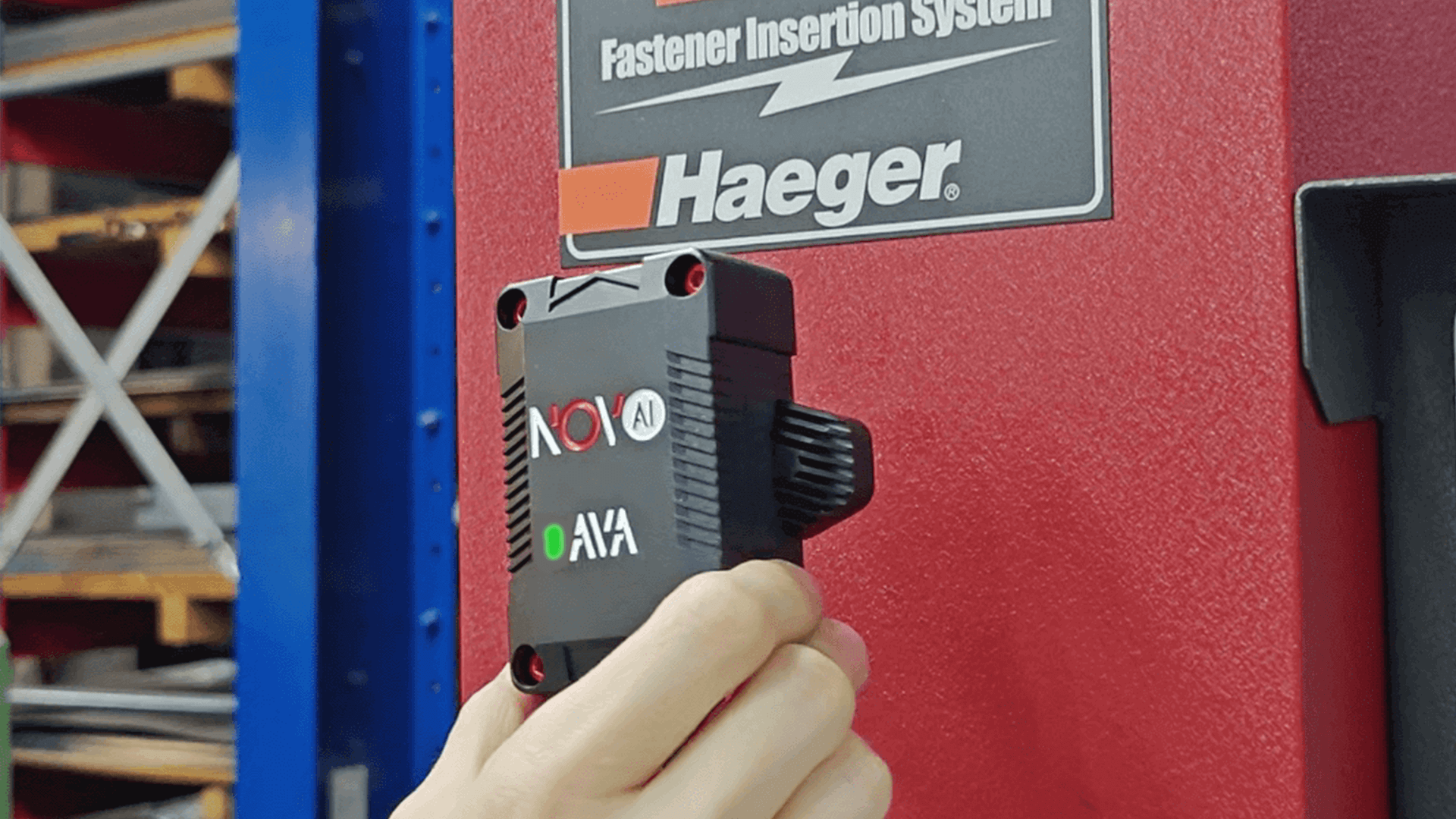
This is where retrofitting becomes crucial. Retrofitting refers to equipping older, non-digital machines with external sensors and interfaces that allow them to communicate operational data. Instead of replacing perfectly functional equipment—an extremely costly and disruptive process—companies can bridge the digital gap and bring legacy assets into the AI era.
The logic is simple but powerful:
You don’t need every machine to be smart.
You need every machine to be visible.
Once visibility is established—through vibration sensors, power meters, microphones, or temperature probes—you can begin to standardize the data. The next step is to stream that data through middleware platforms (either on the edge or in the cloud) that structure and normalize it for further use.
When combined with the structured data from newer smart-enabled machines, you now have a unified data layer. This layer becomes the backbone of advanced applications: dashboards, alerts, predictive analytics, and eventually—AI-driven decision-making.
Far from being a compromise, retrofitting is now a proven strategy adopted across leading manufacturing sectors. It’s fast to implement, cost-effective, and flexible enough to scale with the business.
Next, we’ll dive deeper into how this strategy works in practice: what components are needed, what kinds of data are most useful, and how it all flows together into an AI-ready system.
Building an AI-Ready Architecture — Step by Step
Creating an AI-ready shop-floor when you operate a mix of legacy and modern machines requires a layered, modular approach. At Novo AI, we’ve developed a four-step methodology that has been successfully deployed in dozens of industrial settings. Here’s how it works in detail:
1. Sensor-Based Retrofitting: Making Legacy Machines Speak
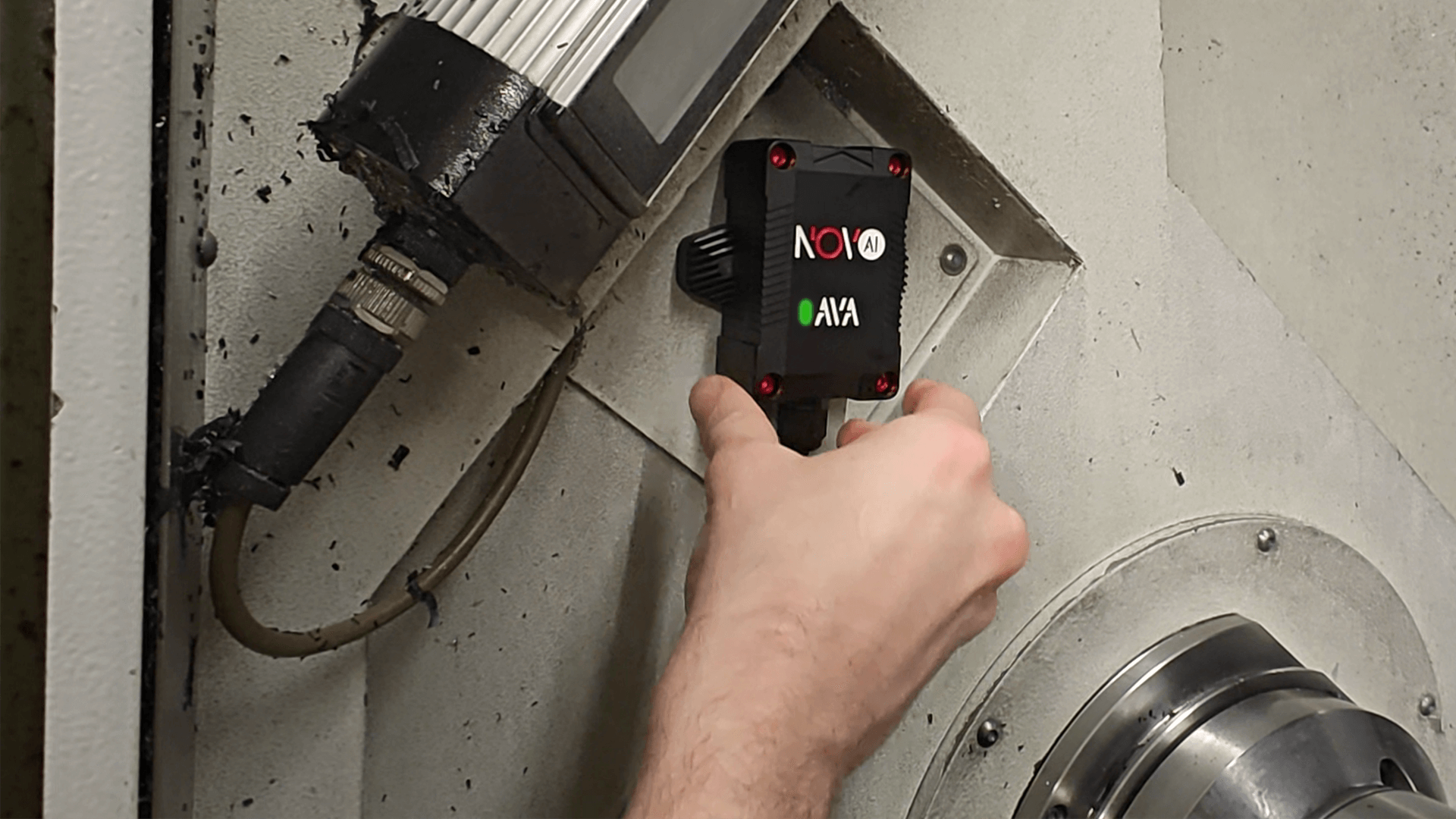
Most older machines don’t expose digital outputs—but they still emit signals. The first step is to capture these signals:
Vibration Sensors: Reveal machine behavior such as idling, operation, or failure patterns.
Acoustic Sensors: Capture process-specific sound signatures, such as cutting, pressing, or stopping.
Temperature Sensors: Indicate abnormal heat buildup, useful in both mechanical and electrical systems.
Current Transformers (CTs): Monitor energy usage and indirectly reveal machine states.
Sensors are mounted non-invasively—no need to access the machine’s control logic or PLC. This avoids the risk of invalidating warranties or damaging systems. All data is timestamped at the source and pushed to an edge device for initial processing.
2. Edge-Based Middleware: Translating Signals into Structured Data
Once raw sensor data is collected, the next step is normalization:
Our edge device uses embedded AI models and rule-based logic to classify machine states in real time: Production, Idle, Off, or Error.
These classifications are computed locally using signal processing and machine learning techniques, minimizing latency.
All outputs are converted into a common schema (e.g., JSON or MQTT topics), regardless of the original machine or sensor type.
This ensures a plug-and-play interface with your broader IT or cloud systems.
3. Data Integration: Creating Operational Transparency
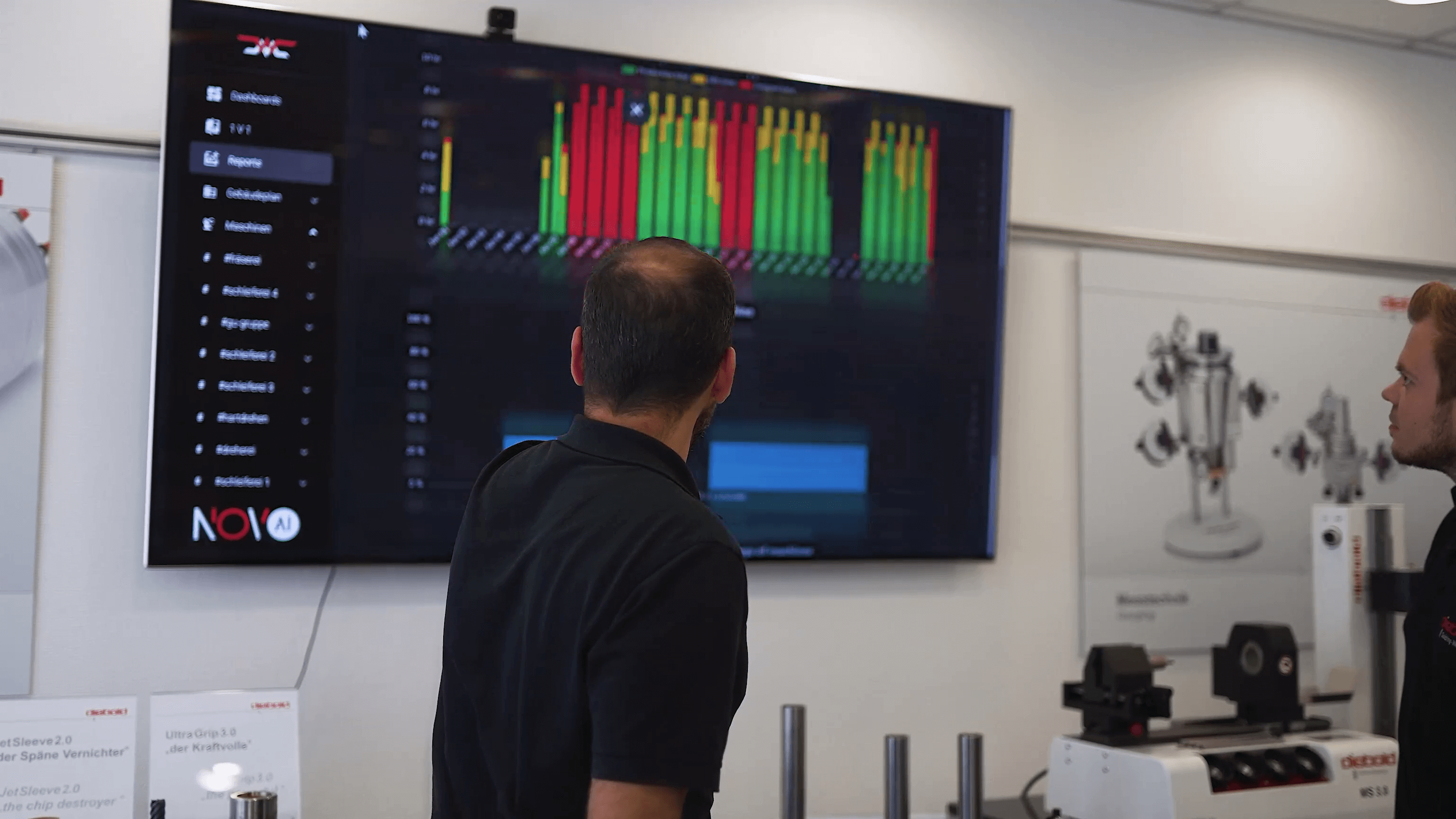
The structured machine data is sent to a central platform (cloud or on-premise), where it can be:
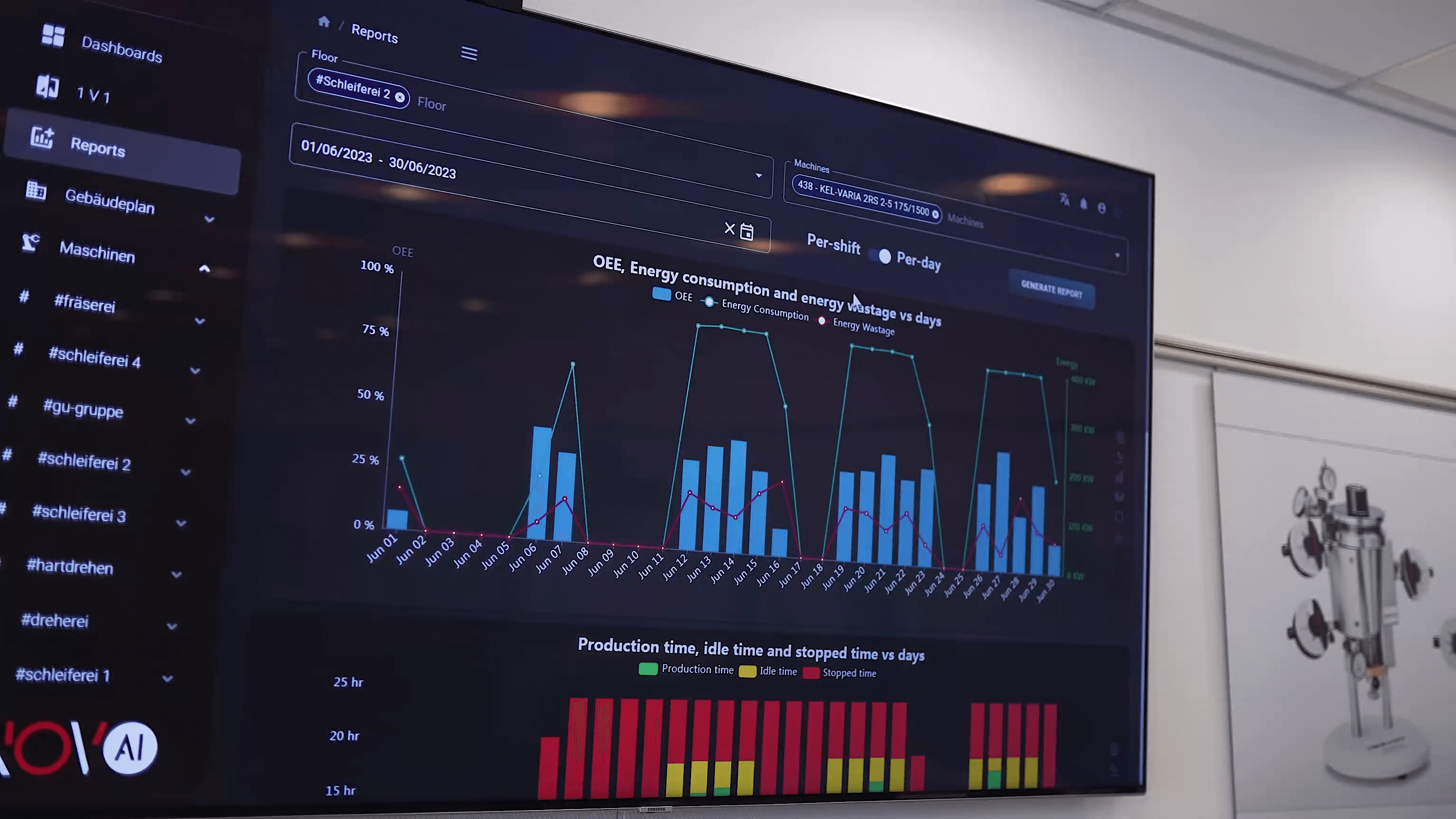
Visualized in real-time dashboards
Mapped against shift schedules, operator inputs, or production targets
Analyzed historically for trends, downtime causes, and OEE (Overall Equipment Effectiveness) improvement
This provides plant managers and operations teams with end-to-end transparency—a unified view across legacy and modern assets.
4. AI-Driven Optimization: Closing the Feedback Loop
The final—and most powerful—layer is AI integration:
Trained machine learning models detect patterns in machine usage, idle times, tool wear, or production bottlenecks.
These insights can trigger automated actions: maintenance requests, shift reassignments, or even production rerouting.
Operators receive explainable, prioritized suggestions instead of raw alarms.
Critically, Novo AI doesn’t just display data—it understands it and helps you act on it.
No rip-and-replace. No IT chaos. Just scalable intelligence, built on the machines you already have.
The question we started with “What should be our AI-ready strategy for a mixed shop-floor?”—is not a future problem. It’s a now problem. But it’s also a solvable one.
🚀 You don’t need to replace your legacy machines.
🚀 You don’t need to wait until everything is “smart.”
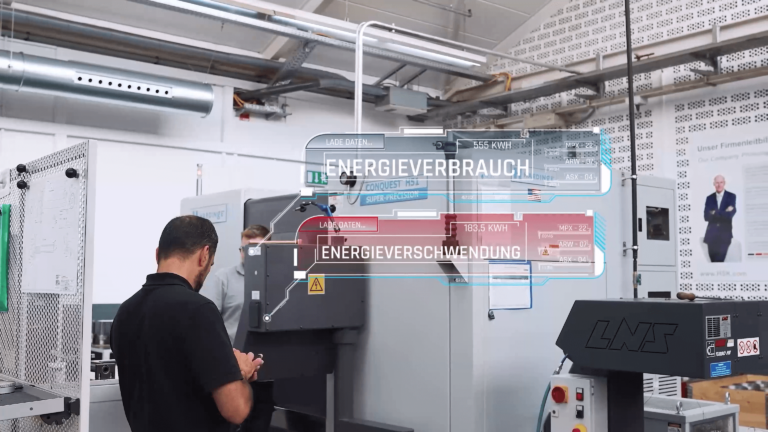
With the right retrofit sensors, edge intelligence, and AI-ready infrastructure, your entire shop-floor—new or old—can become fully transparent, measurable, and optimizable. This approach isn't just about data; it's about creating a connected, responsive factory that learns, adapts, and continuously improves.
At Novo AI, we've helped manufacturers of all sizes—from specialized job shops to high-volume producers—turn fragmented machine environments into harmonized, AI-powered systems. And we can help you do the same.
🚀 Ready to unlock the full potential of your machines?


binance create account
I don’t think the title of your article matches the content lol. Just kidding, mainly because I had some doubts after reading the article.
注册以获取100 USDT
Thanks for sharing. I read many of your blog posts, cool, your blog is very good. https://accounts.binance.info/register-person?ref=IHJUI7TF
binance US-registrera
I don’t think the title of your article matches the content lol. Just kidding, mainly because I had some doubts after reading the article.
Binance注册
Thank you for your sharing. I am worried that I lack creative ideas. It is your article that makes me full of hope. Thank you. But, I have a question, can you help me?
binance skapa konto
Thanks for sharing. I read many of your blog posts, cool, your blog is very good.
Binance美国注册
Thank you for your sharing. I am worried that I lack creative ideas. It is your article that makes me full of hope. Thank you. But, I have a question, can you help me?
Binance推荐代码
Your article helped me a lot, is there any more related content? Thanks!
binance тркеу
Can you be more specific about the content of your article? After reading it, I still have some doubts. Hope you can help me.
注册
I don’t think the title of your article matches the content lol. Just kidding, mainly because I had some doubts after reading the article. https://www.binance.info/register?ref=IHJUI7TF
Binance推荐代码
Thank you for your sharing. I am worried that I lack creative ideas. It is your article that makes me full of hope. Thank you. But, I have a question, can you help me?
Skapa personligt konto
I don’t think the title of your article matches the content lol. Just kidding, mainly because I had some doubts after reading the article. https://www.binance.com/register?ref=QCGZMHR6
binance "oppna konto
Can you be more specific about the content of your article? After reading it, I still have some doubts. Hope you can help me.
skapa binance-konto
Thanks for sharing. I read many of your blog posts, cool, your blog is very good.
skapa ett binance-konto
Your point of view caught my eye and was very interesting. Thanks. I have a question for you.
binance sign up bonus
Thanks for sharing. I read many of your blog posts, cool, your blog is very good.
registrera dig f"or binance
I don’t think the title of your article matches the content lol. Just kidding, mainly because I had some doubts after reading the article. https://www.binance.info/register?ref=JW3W4Y3A
创建Binance账户
Can you be more specific about the content of your article? After reading it, I still have some doubts. Hope you can help me. https://accounts.binance.info/fr-AF/register?ref=JHQQKNKN
开设Binance账户
Thanks for sharing. I read many of your blog posts, cool, your blog is very good.
Binance注册奖金
Your point of view caught my eye and was very interesting. Thanks. I have a question for you.
Bonus d'inscription Binance
Thanks for sharing. I read many of your blog posts, cool, your blog is very good. https://accounts.binance.com/ES_la/register-person?ref=VDVEQ78S
Binance推荐代码
Thanks for sharing. I read many of your blog posts, cool, your blog is very good. https://www.binance.com/register?ref=JW3W4Y3A
binance
I don’t think the title of your article matches the content lol. Just kidding, mainly because I had some doubts after reading the article. https://www.binance.com/register?ref=IHJUI7TF
binance
Your article helped me a lot, is there any more related content? Thanks! https://www.binance.com/join?ref=JW3W4Y3A
"oppna binance-konto
I don’t think the title of your article matches the content lol. Just kidding, mainly because I had some doubts after reading the article.
Binance推荐奖金
Your point of view caught my eye and was very interesting. Thanks. I have a question for you.
binance sign up bonus
Thanks for sharing. I read many of your blog posts, cool, your blog is very good.
Create Personal Account
Thanks for sharing. I read many of your blog posts, cool, your blog is very good.
Mag-sign up upang makakuha ng 100 USDT
Your article helped me a lot, is there any more related content? Thanks!
Бонус за регистрацию в binance
Your point of view caught my eye and was very interesting. Thanks. I have a question for you.
Skapa personligt konto
Your point of view caught my eye and was very interesting. Thanks. I have a question for you.
binance konts
Can you be more specific about the content of your article? After reading it, I still have some doubts. Hope you can help me. https://accounts.binance.com/register-person?ref=QCGZMHR6
注册以获取100 USDT
I don’t think the title of your article matches the content lol. Just kidding, mainly because I had some doubts after reading the article.
binance anm"alan
Thank you for your sharing. I am worried that I lack creative ideas. It is your article that makes me full of hope. Thank you. But, I have a question, can you help me?
binance nos registro
I don’t think the title of your article matches the content lol. Just kidding, mainly because I had some doubts after reading the article.
binance Konto er"offnen
I don’t think the title of your article matches the content lol. Just kidding, mainly because I had some doubts after reading the article.
Зареструватися
Your point of view caught my eye and was very interesting. Thanks. I have a question for you.
www.binance.info注册
Can you be more specific about the content of your article? After reading it, I still have some doubts. Hope you can help me.
Binance代码
I don’t think the title of your article matches the content lol. Just kidding, mainly because I had some doubts after reading the article.
binance h"anvisning
Your article helped me a lot, is there any more related content? Thanks!
binance register
Can you be more specific about the content of your article? After reading it, I still have some doubts. Hope you can help me. https://www.binance.com/join?ref=IXBIAFVY
binance
Can you be more specific about the content of your article? After reading it, I still have some doubts. Hope you can help me.
criar conta na binance
Thanks for sharing. I read many of your blog posts, cool, your blog is very good.
best binance referral code
Thanks for sharing. I read many of your blog posts, cool, your blog is very good. https://www.binance.com/register?ref=IXBIAFVY
Binance
Can you be more specific about the content of your article? After reading it, I still have some doubts. Hope you can help me.
Skapa ett gratis konto
Your article helped me a lot, is there any more related content? Thanks!
"oppna binance-konto
Your article helped me a lot, is there any more related content? Thanks! https://accounts.binance.com/en/register-person?ref=JHQQKNKN
binance prijavnica
Thanks for sharing. I read many of your blog posts, cool, your blog is very good.
Crea una cuenta gratis
Your article helped me a lot, is there any more related content? Thanks!
8XBet Où est-ce ? kadwyn.za.com Enquête et signaux d’alarme 2026
ユーザーは kadwyn.za.com に対して細心の注意を払う必要があります。入金ボーナスに関しては典型的な緊急戦略を採用し、銀行振込と電子ウォレットをサポートしていますが、所有者は完全に隠蔽されており、ドメインはまだ数日しか経っていません。Visit us: 8XBet Où est-ce ? kadwyn.za.com Enquête et signaux d’alarme 2026
"oppna ett binance-konto
Your article helped me a lot, is there any more related content? Thanks!
registrera dig f"or binance
Thanks for sharing. I read many of your blog posts, cool, your blog is very good.
binance register
Can you be more specific about the content of your article? After reading it, I still have some doubts. Hope you can help me.
创建免费账户
I don’t think the title of your article matches the content lol. Just kidding, mainly because I had some doubts after reading the article. https://www.binance.info/register?ref=IXBIAFVY
M mt tài khon binance
Thanks for sharing. I read many of your blog posts, cool, your blog is very good. https://accounts.binance.info/es-AR/register?ref=UT2YTZSU
binance-
Thanks for sharing. I read many of your blog posts, cool, your blog is very good.
Binance注册奖金
Can you be more specific about the content of your article? After reading it, I still have some doubts. Hope you can help me.
registrera dig f"or binance
Thanks for sharing. I read many of your blog posts, cool, your blog is very good.
Binance推荐代码
Can you be more specific about the content of your article? After reading it, I still have some doubts. Hope you can help me. https://www.binance.com/vi/register?ref=MFN0EVO1
skapa binance-konto
Your point of view caught my eye and was very interesting. Thanks. I have a question for you.
binance Sign Up
Your article helped me a lot, is there any more related content? Thanks!
binance Empfehlungscode
I don’t think the title of your article matches the content lol. Just kidding, mainly because I had some doubts after reading the article.
binance US-registrera
Thank you for your sharing. I am worried that I lack creative ideas. It is your article that makes me full of hope. Thank you. But, I have a question, can you help me?
binance Sign Up
Your article helped me a lot, is there any more related content? Thanks! https://www.binance.com/register?ref=QCGZMHR6
创建个人账户
Thank you for your sharing. I am worried that I lack creative ideas. It is your article that makes me full of hope. Thank you. But, I have a question, can you help me?
Binance账户
Your point of view caught my eye and was very interesting. Thanks. I have a question for you. https://www.binance.info/tr/register?ref=MST5ZREF
Registrera
I don’t think the title of your article matches the content lol. Just kidding, mainly because I had some doubts after reading the article. https://www.binance.com/register?ref=JW3W4Y3A
b"asta binance h"anvisningskod
I don’t think the title of your article matches the content lol. Just kidding, mainly because I had some doubts after reading the article. https://accounts.binance.info/register-person?ref=IXBIAFVY