Invisible Idle: The Hidden Production Losses Caused by Missing Real-Time Data
How much money vanishes while machines quietly wait? The phrase "invisible idle" describes the time machines spend powered or set up but not producing — and that unseen downtime is the silent leak in many Mittelstand factories. Production managers estimate losses, but without hard data those estimates are guesses. Modern machine monitoring shows invisible idle can consume 5-20% of productive time, turning into tens of thousands of euros annually for small-to-medium (SME) plants.
The Real Impact of Invisible Idle
Start with an immediate example: a single CNC turning center that sits idle 30 minutes per shift because operators wait for setup instructions or material. For a plant with five similar machines, three shifts, and a part margin of €80 per hour of full-load production, that silent 30-minute idle becomes roughly 1,700 of lost margin each week — more than €40,000 per year. Multiply across mixed fleets and the numbers escalate quickly.
Industry reports quantify the macro problem. Siemens' "The True Cost of Downtime" (2024) found unscheduled downtime can sap roughly 11% of revenue for the world's 500 largest industrial firms; it also published industry-specific figures showing automotive manufacturers can lose up to $2.3 million per hour in extreme cases (Siemens, 2024). Smaller manufacturers will not hit millions per hour, but percentages matter: 5-11% of turnover in an SME still equals thousands to hundreds of thousands of euros a year.
Why is invisible idle so persistent? Two reasons. First, lack of real-time data: planning uses shift reports and gut feel instead of clocked machine states. Second, heterogeneous machine fleets — old mechanical presses coexist with newer CNCs — make automatic data capture difficult. Retrofitting is feasible, but requires process-agnostic sensors and an analytics layer capable of turning pulses and vibrations into meaning.
The Real Impact of Invisible Idle 1: Invisible Idle Defined
Invisible idle is any period when the machine is technically available but not producing value: warm-up cycles, manual micro-stops, waiting for material, or operator breaks that are not logged. It differs from completed downtime where machines are clearly off because invisible idle frequently goes unrecorded. That invisibility misleads planning and obscures the true OEE picture.
The Real Impact of Invisible Idle 2: Why Data Matters
Data turns assumptions into decisions. When a machine's states (running, idle, setup, fault) are captured in real time, production managers can slice performance by shift, SKU, or operator. This reveals recurring bottlenecks: a feeder jam at 10:15 each morning or long setup times on Mondays. Without machine monitoring, these patterns remain anecdotal and hard to fix.
The Real Impact of Invisible Idle 3: Typical Loss Numbers
Published sources vary: ITIC and other industry analyses report average downtime costs ranging widely from tens of thousands to several hundred thousand dollars per hour depending on industry. Siemens compresses this into a percentage: ~11% lost revenue at the largest scale. For practical factory-level calculations, aim to measure idle minutes per machine per shift and apply margin-per-hour to turn minutes into euros.
The Real Impact of Invisible Idle 4: How Monitoring Helps
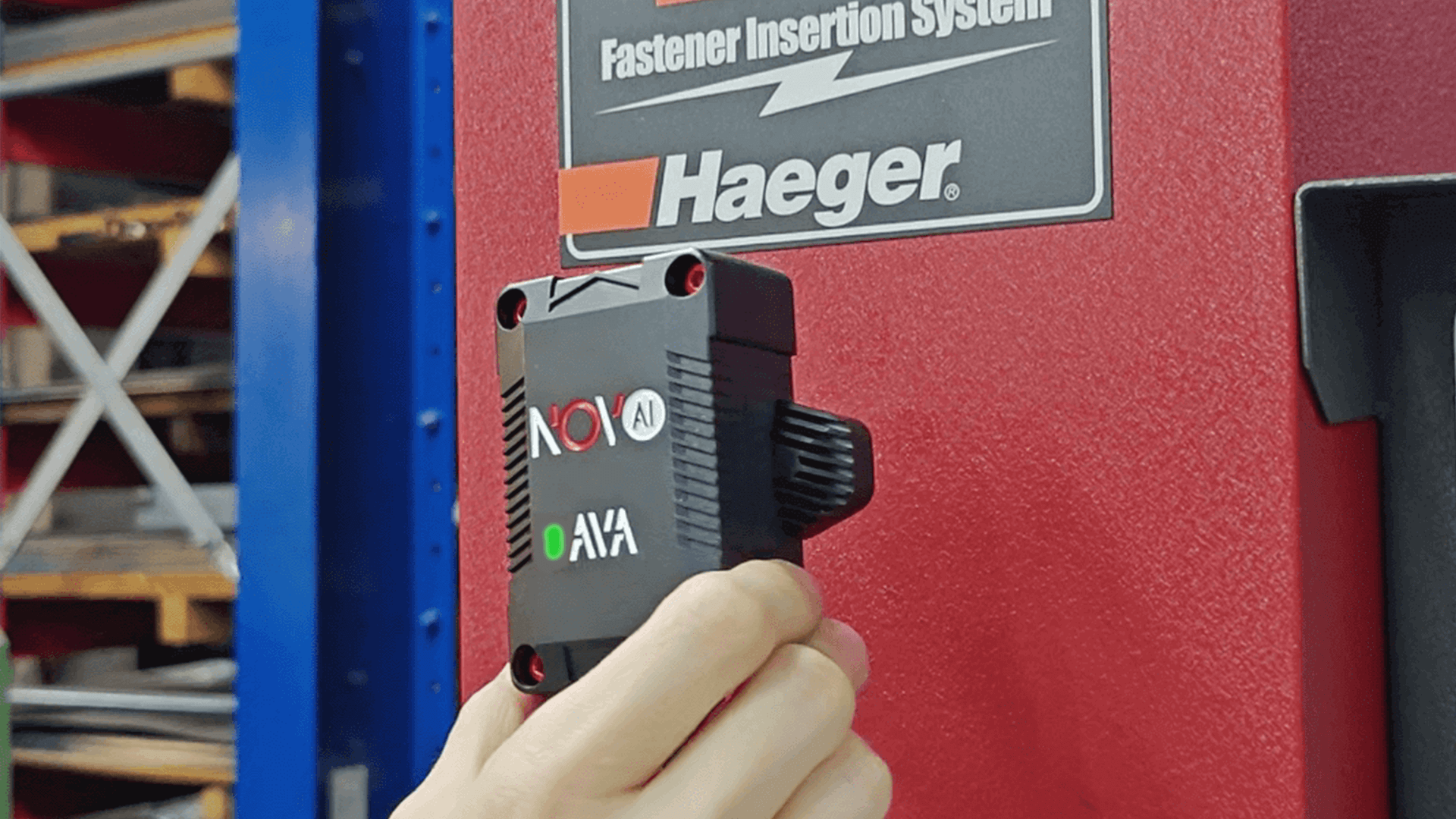
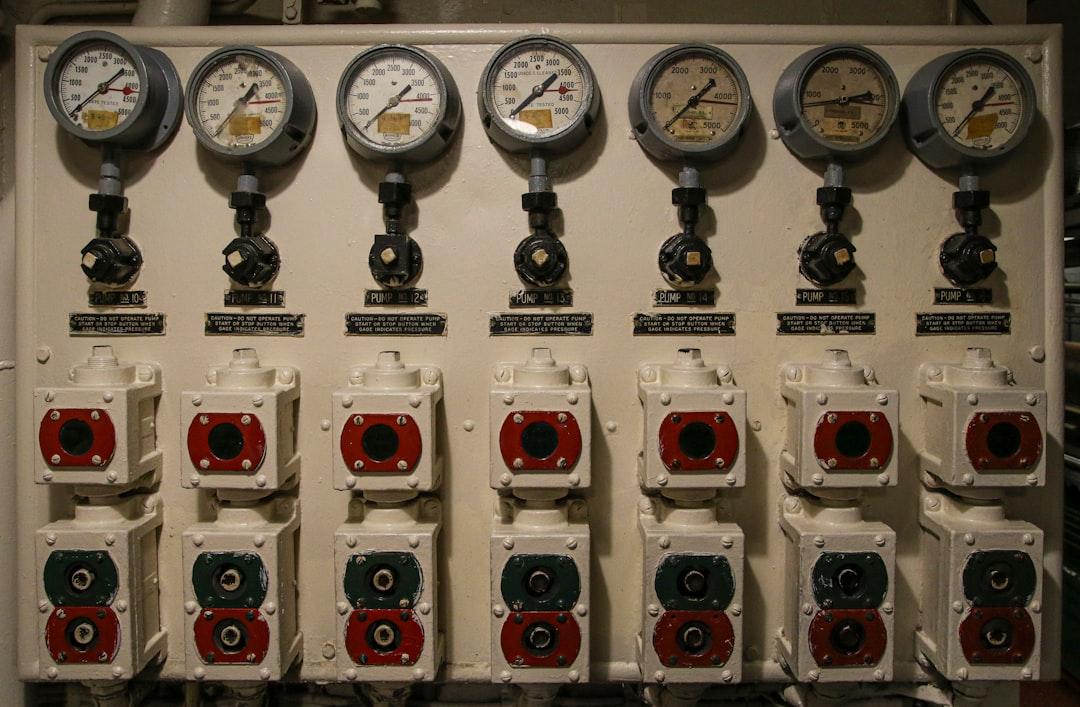
Real-time monitoring converts invisible idle into actionable events. A sensor-based module that recognizes cycles and micro-stops reduces the time needed to diagnose causes. Modern solutions like Novo AI's WatchMen platform use retrofittable sensor modules and local analytics to detect these idle states and alert teams — turning guesswork into targeted interventions.
Hidden Costs of Invisible Idle
Invisible idle increases direct labor cost, reduces throughput and inflates lead times. Consider labor: workers stand by machines during micro-stops but their time is often charged to production which creating an invisible payroll tax on inefficient processes. Throughput penalties show up later: forecast accuracy degrades, safety stocks rise, and the result is capital tied up in work-in-progress inventory.
Beyond pure throughput, quality suffers. Intermittent stops interrupt thermal cycles, especially in plastic processing or heat-treatment processes, leading to higher scrap rates. Energy inefficiency is another knock-on effect: machines idling under power still draw energy; without granular tracking, energy teams cannot optimize idle-power modes or shift consumption out of peak tariffs.
Data supports the business case. Evocon and Oden reports estimate that data-driven production monitoring can cut unplanned downtime significantly and even reduce invisible idle by rebalancing work and scheduling preventive maintenance. These improvements are where OEE improvements (case study: 30% to 60%) become realistic for SMEs when measurement and interventions are applied.
Additional evidence comes from ABB's 2023 maintenance survey (reported by industry press) which indicated outages can cost a typical industrial business about $125,000 per hour in certain sectors. For Mittelstand manufacturers that figure translates into much smaller hourly totals, but the proportional damage is similar: recurring micro-stops accumulate quickly into significant monthly losses.
Invisible Idle Scenarios
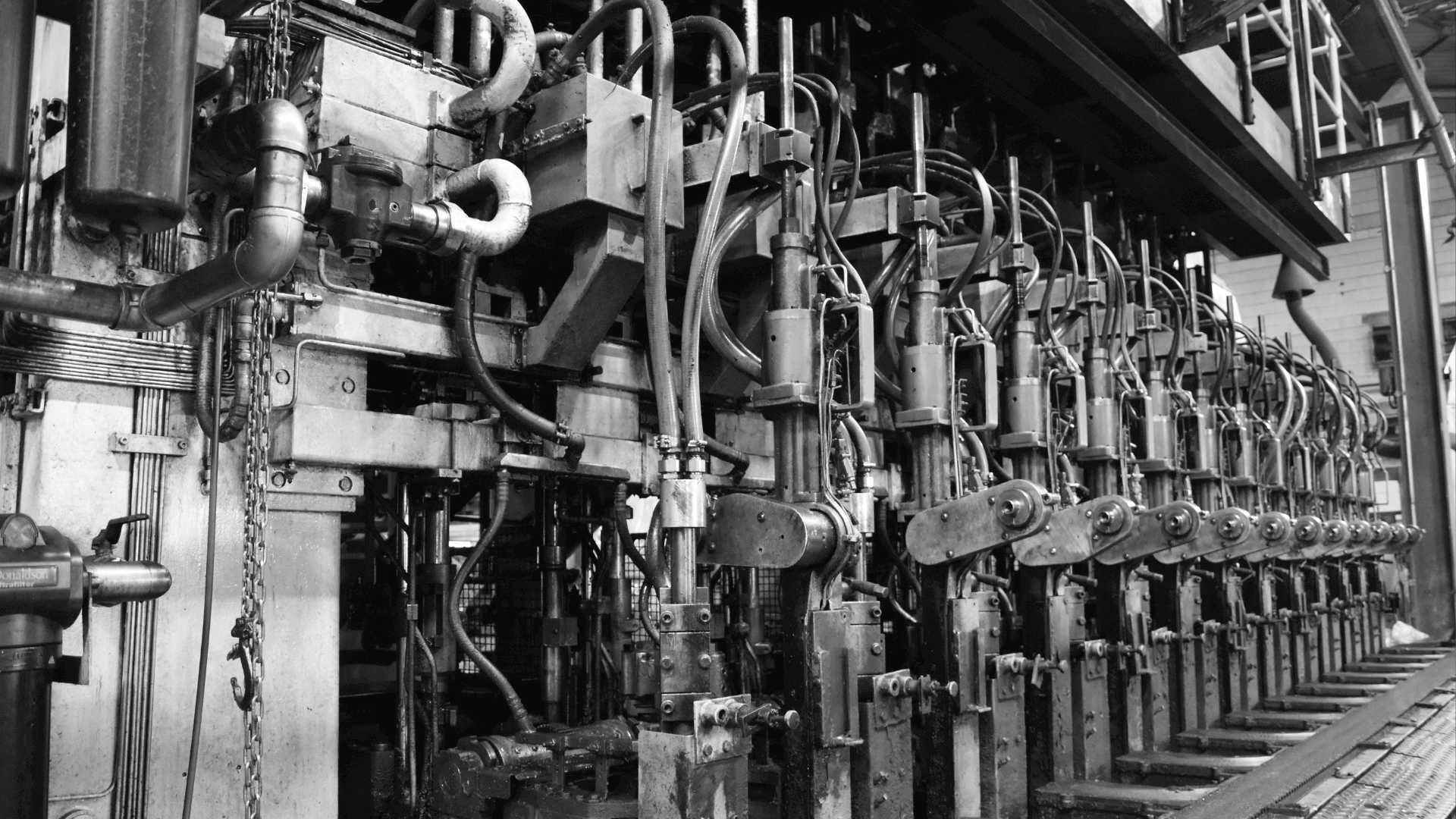
Scenario A: A German precision parts shop with 12 machines reported 4 hours of invisible idle per day across its plant. At an average margin of €40/hour per machine, that equated to €19,200 monthly lost margin. Installing retrofittable sensors and a local analytics layer revealed recurring 20-minute micro-stops tied to tool changeover. After process changes, invisible idle dropped by 60% and monthly margin loss fell below 8,000.
Scenario B: An assembly line experienced unpredictable bottlenecks. Managers assumed material shortages, but machine data showed that one feeder's pneumatic fault caused repeated 3-minute stops every hour. Fixing the feeder reduced idle time enough to increase daily output by 8%, improving on-time delivery and lowering overtime.
These scenarios reflect a common path: measure — diagnose — act. The measurement step is the hardest for many Mittelstand firms because of legacy equipment and limited IT staff. Solutions that are machine- and process-agnostic reduce implementation friction and shorten payback periods.
Practical Steps to Reduce Invisible Idle Step 1: Start with a Baseline
Use simple retrofittable sensors to capture machine states for 2 weeks. Track metrics: minutes idle per shift, frequency of micro-stops, mean time between stops. Use simple dashboards to present findings to line supervisors and shop-floor teams weekly; empower daily stand-ups to act on alerts these behavior changes compound savings over time.
Practical Steps to Reduce Invisible Idle Step 2: Prioritize Interventions
Not every idle event is worth fixing. Prioritize by frequency × cost. A 1-minute stop that occurs 50 times per day will cost more than a 30-minute stop that happens weekly. Use Pareto analysis to target the 20% of causes that produce 80% of idle minutes.
Practical Steps to Reduce Invisible Idle Step 3: Local analytics and securitye
Manufacturers need analytics that run locally to respect data sovereignty and reduce latency. WatchMen's approach emphasizes secure, local processing and dashboards that translate pulses and vibrations into machine states without moving raw data off-premises.
Practical Steps to Reduce Invisible Idle Step 4: Tie to OEE
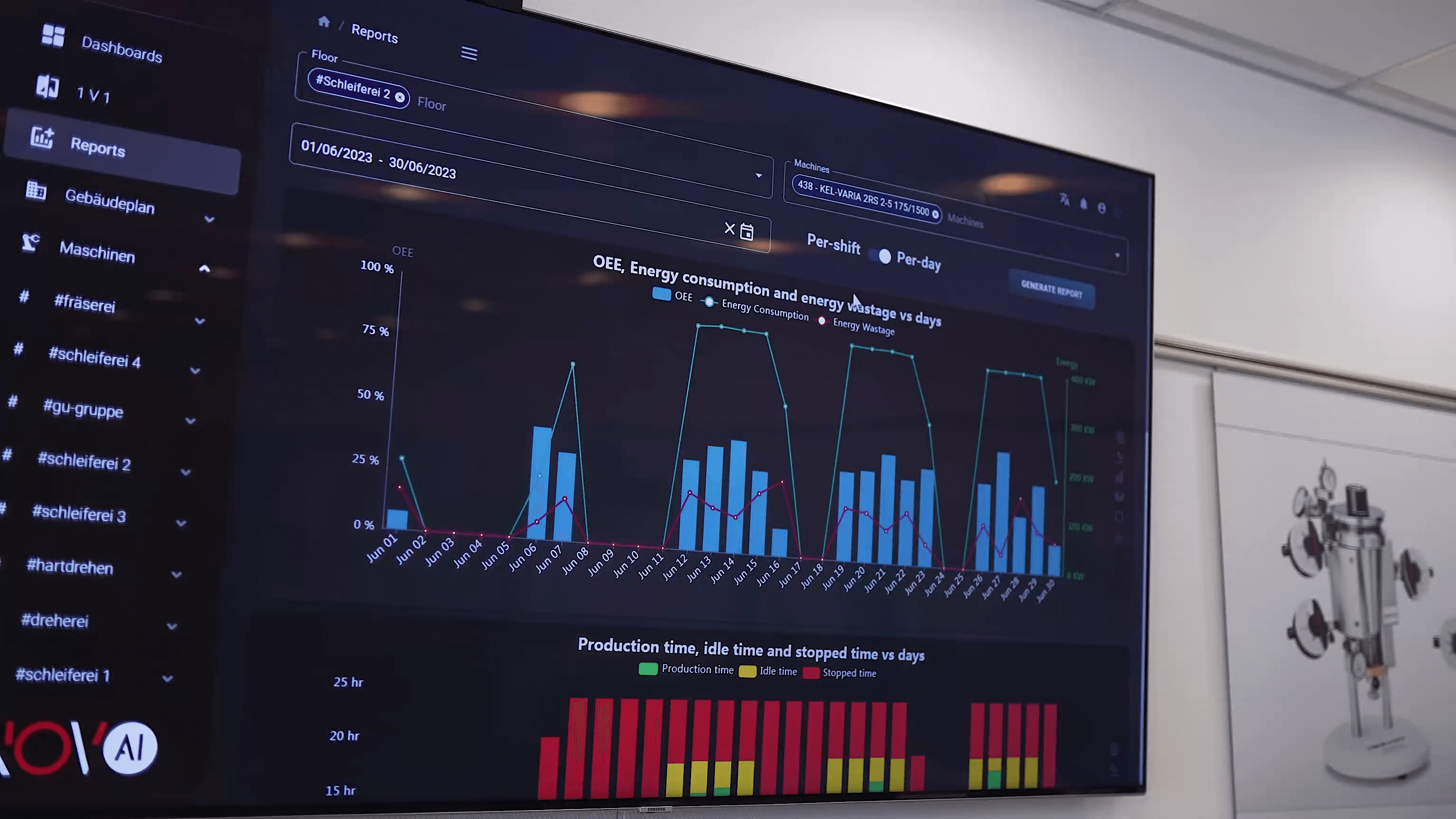
Tie improvements to OEE. Replace guess-based reports with measured state-time accounting. When OEE moves from 30% to 60%, the financial impact should be visible in reduced overtime, lower scrap, and improved delivery metrics.
Practical Steps to Reduce Invisible Idle Step 5: Continuous reviewe
Make invisible idle reduction a continuous KPI. Set targets: reduce idle minutes per machine per shift by 30% in six months, and aim for under 10 idle minutes per shift as a medium-term goal. Run monthly reviews that combine machine-state graphs with maintenance logs and operator feedback; this closes the loop between data and shop-floor action. Track ROI monthly and publish results to management to maintain momentum.
Optional Insight: Energy & Sustainability
Invisible idle affects energy consumption and sustainability goals. Idle machines on heating or hydraulic systems consume power and create a hidden carbon footprint. Tracking idle energy use enables targeted power-down schedules and equipment retrofits. For example, small compressors running idle can account for 10-15% of shop-floor energy waste; curbing that waste often pays back in months.
Benchmarking idle energy also helps with EU regulatory reporting and corporate sustainability metrics. Energy tracking combined with production monitoring gives a fuller ROI calculation that includes both margin recovery and cost avoidance in energy spend.
The Path Forward
Invisible idle is not fate. It is measurable and fixable. For Mittelstand manufacturers, the first step is to stop relying on shift reports and start capturing machine states in real time. Modern solutions like Novo AI's WatchMen platform support retrofittable sensing, local analytics, and secure dashboards that make invisible idle visible.
If you manage production, ask your team: where do we make assumptions about machine availability? Which machines never appear in maintenance logs yet cause delays? Start a 30-day measurement pilot on a representative line and quantify your baseline — you will likely find a fast payback within months. Consider using a cross-functional team including maintenance, production and IT to ensure quick root-cause resolution and sustainable process improvement.
References
- Siemens - The True Cost of Downtime (2024) - Global study on unplanned downtime (accessed: 2026-02-18)
- Oden Technologies - Downtime in Manufacturing - Analysis and practical examples (accessed: 2026-02-18)
- ISM - The Monthly Metric: Unscheduled Downtime (2024) - Industry commentary on Siemens findings (accessed: 2026-02-18)
- Industry USA - ABB survey summary (2023) - Reported maintenance outage costs (accessed: 2026-02-18)