No Machine Data Means Lost Performance. Time. Money.
Precise measurement is the foundation of higher performance, lower costs, and lasting competitive advantage.
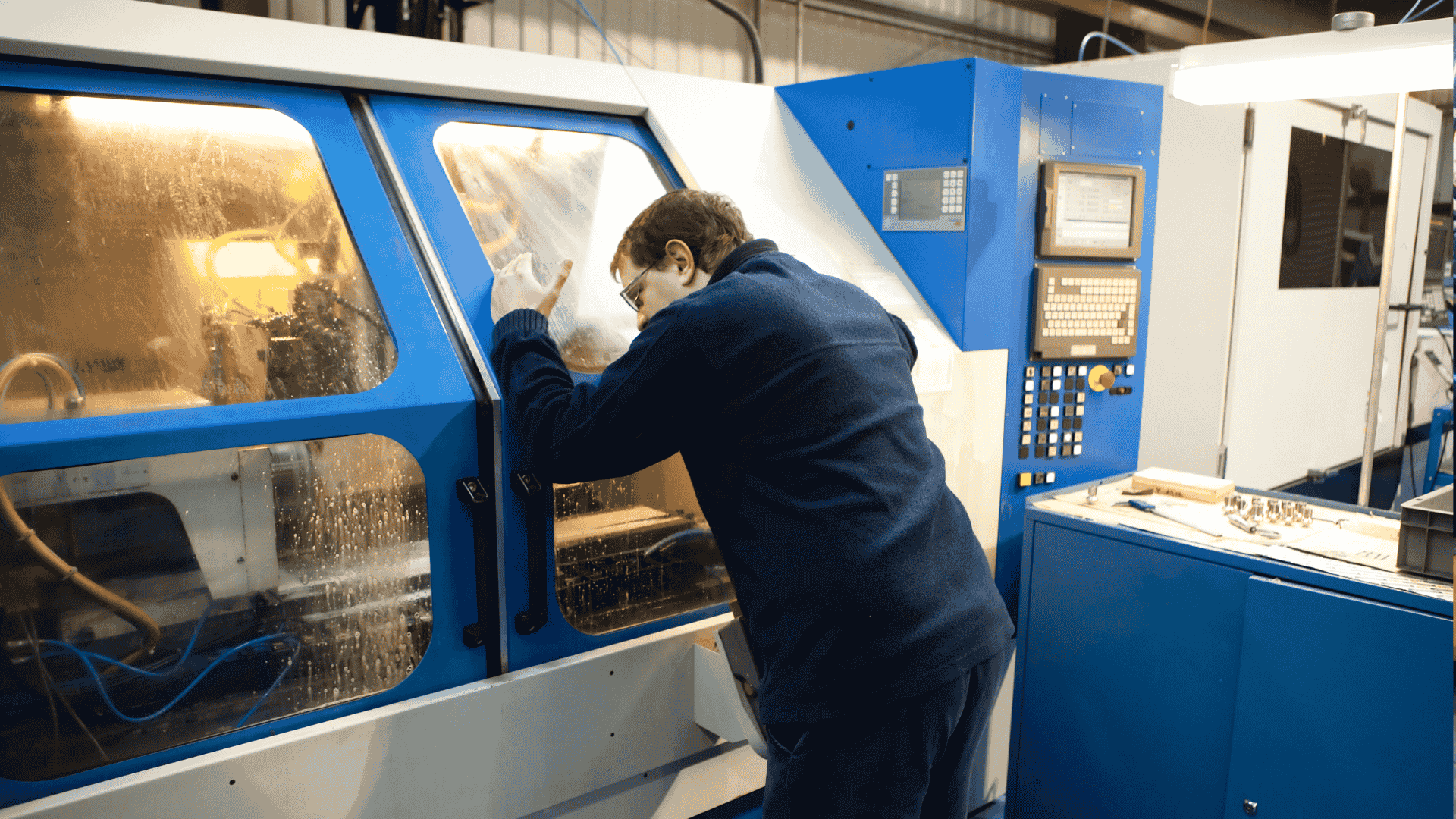
Without machine data acquisition, efficiency is nothing more than an estimate. In most manufacturing companies, production still runs without real machine data collection.
67% of industrial companies experience at least one unplanned production shutdown every month – at an average cost of €147,000 per hour.
Machine data collection is no longer an advantage – it’s a requirement.
The future is built on data, not intuition.
Others guess. You know. While others rely on gut feeling, you see downtime, idle time, and energy use in real time.
Machine data replaces assumptions with facts – every minute, every machine, every cause.
VDMA emphasizes that machine data collection is the foundation of every successful Industry 4.0 strategy.
45%
Ø OEE Increase
Within 12 Months
30%
Ø Higher Machine Availability
Within 12 Months
28%
Ø Less Energy Waste
Within 12 Months
"Thanks to the AI sensors, we now have access to real-time machine data that helps us make better decisions every day. With Novo AI, we increased average shopfloor OEE from 30% to 60%—and in some cases even higher."
Salvatore Viola, COO
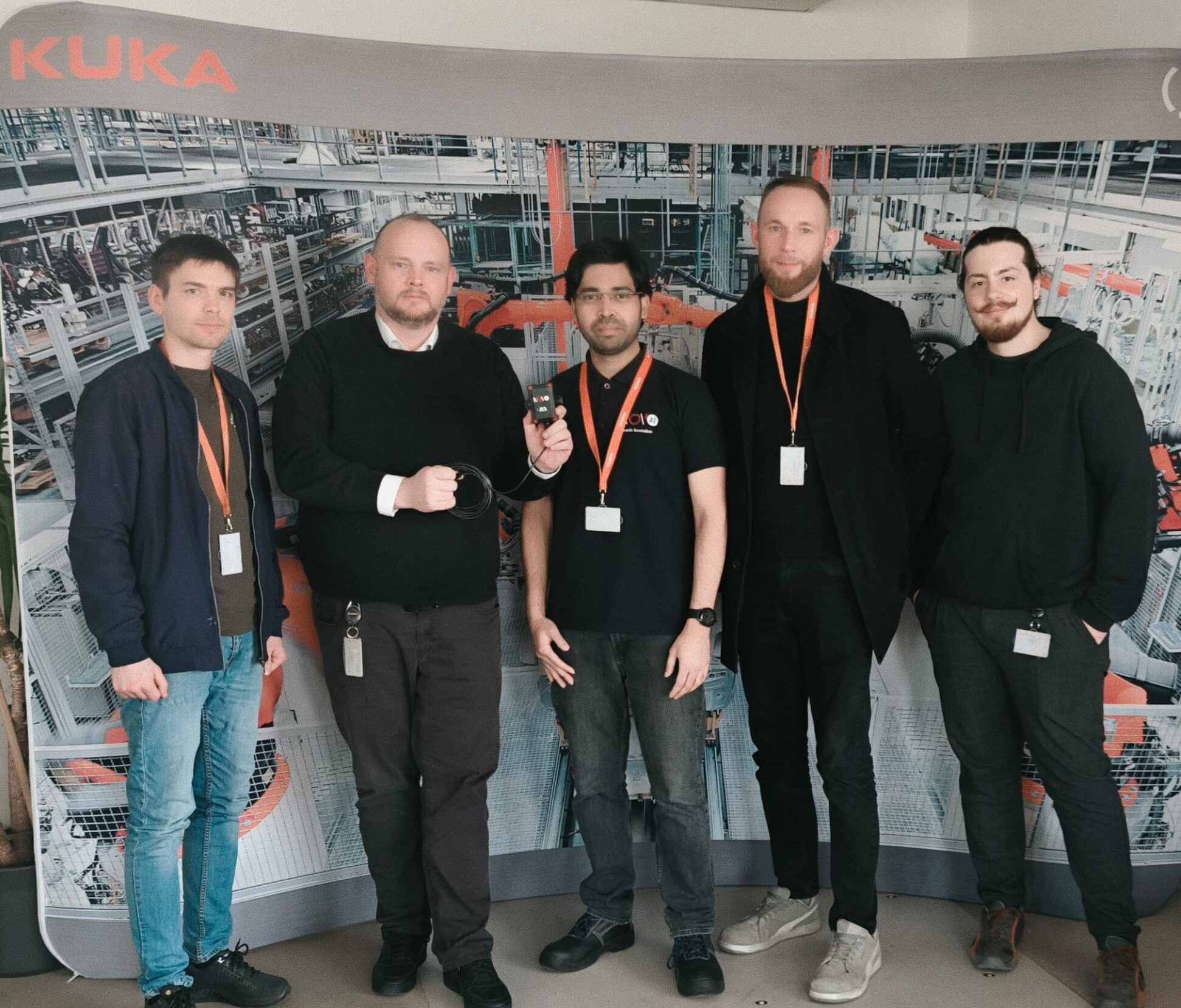
“Integrating all these machines initially seemed almost impossible—until we discovered Novo AI. Today, we have real-time visibility across our entire production and can identify optimization potential instantly. This technology has fundamentally changed how we operate. We can no longer imagine running production without machine data.”
Torsten Jörges, CEO
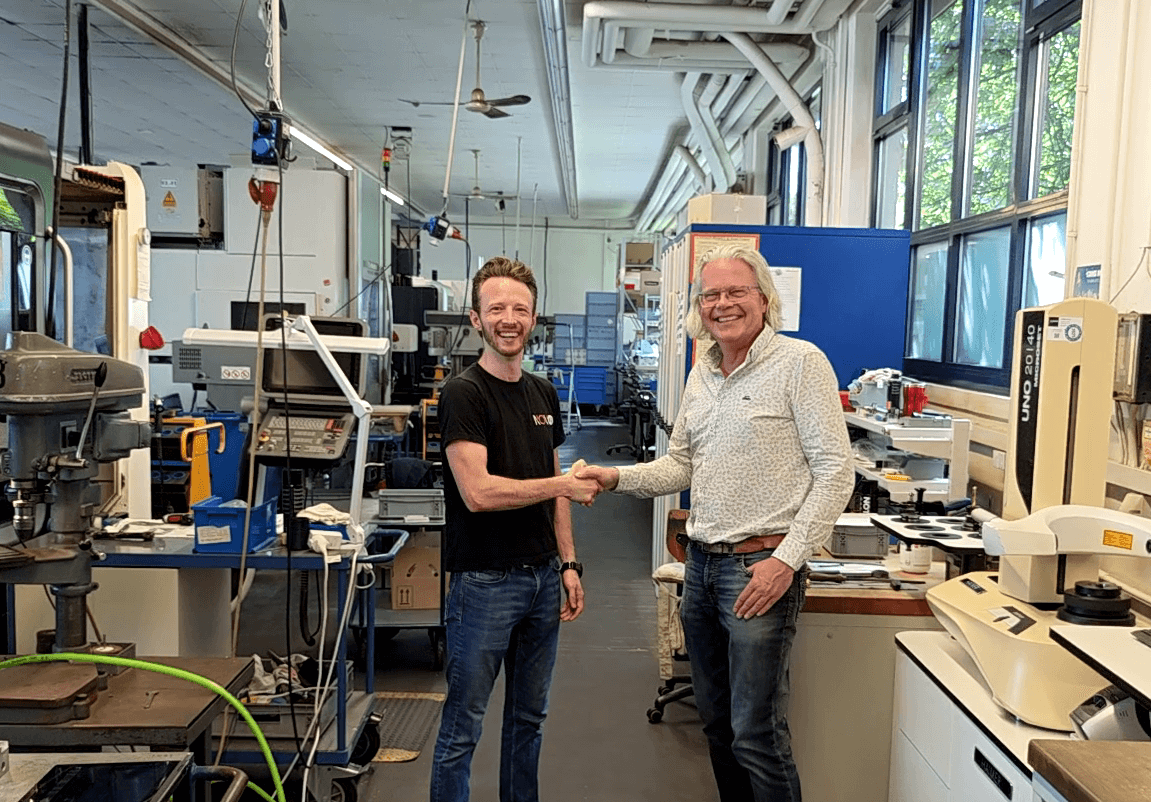
“Before Novo AI, we were forced to rely on estimates. Understanding how our machines actually performed was a nightmare. Connecting machine data to our ERP felt impossible and far too complex. Today, decisions are faster, more accurate—and daily operations are simply easier.”
Hermann Strathmann, CEO
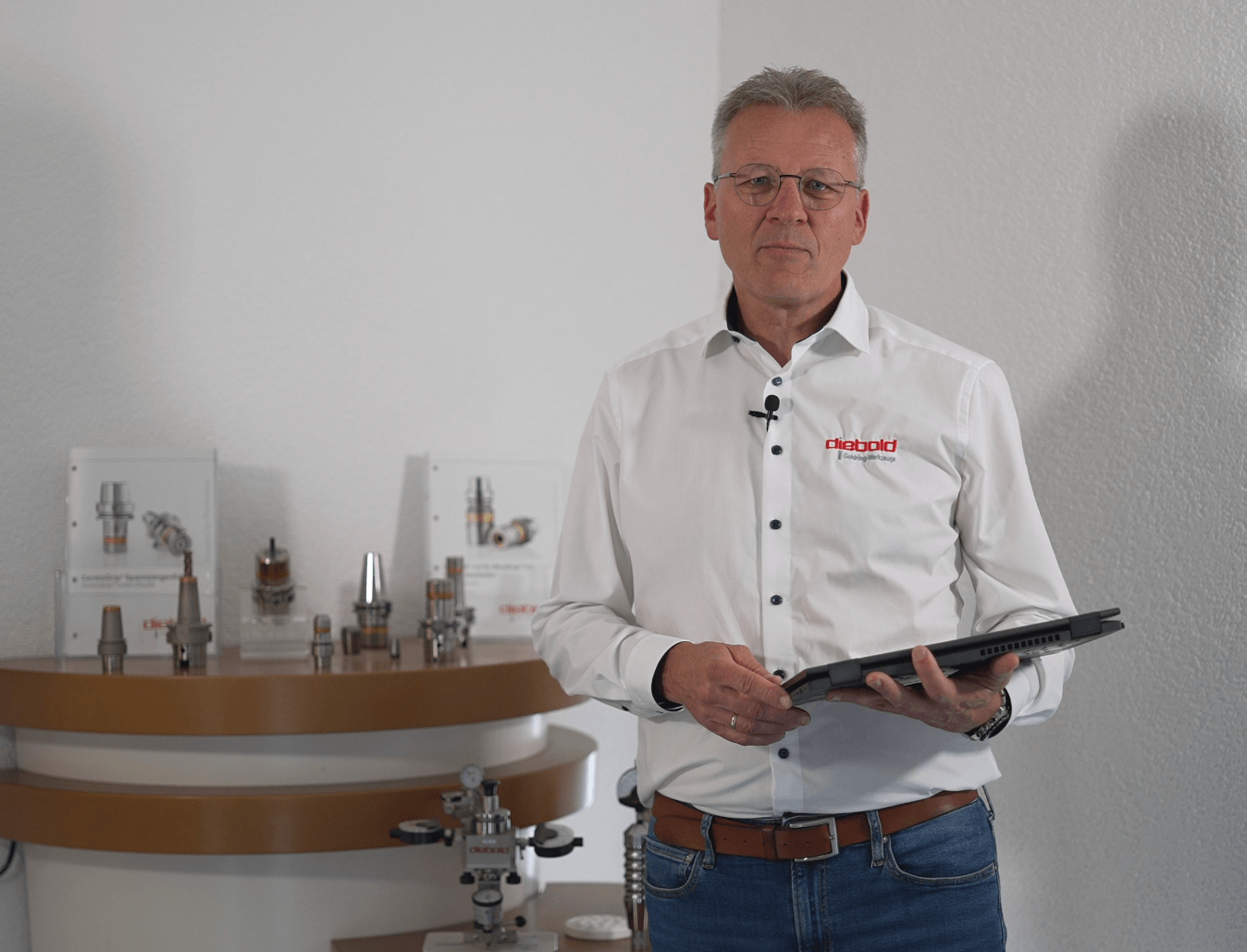
“‘Made in Germany’ can only survive with automation and digitalization. With Novo AI, we now have intelligent machine data collection and processing—and were able to connect all our machines in record time.”
Frank Ringat, CEO
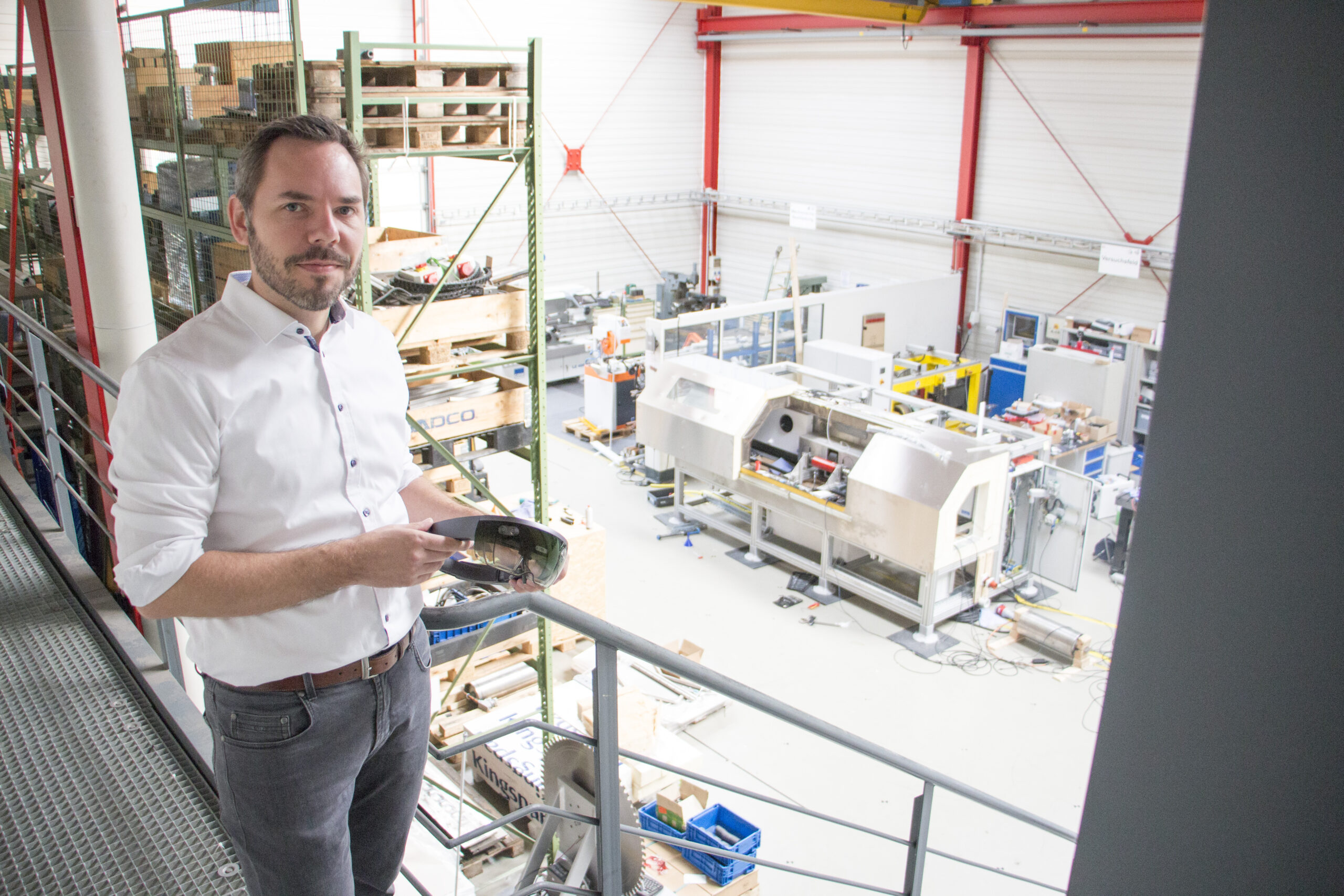
“Our mid-sized manufacturing customers are being truly transformed by Novo AI’s solutions. With minimal effort, they retrofit and digitize their machines intelligently—taking efficiency to an entirely new level.”
Dr.-Ing. Malte Stonis, CEO

“For highly efficient production, the systematic use of machine data is no longer optional—it’s essential. With WatchMen, Novo AI delivers a solution that turns data into real, timely, and easy-to-understand insights. That’s exactly what mid-sized manufacturers need to plan and operate more efficient factories.”
Dr.-Ing. Tobias Heinen, CEO

“Novo AI enabled us to network our machines within days and gain real-time visibility into performance. Implementation was seamless, and we quickly gained valuable insights to optimize our production processes and improve efficiency.”
Torsten Subke, CEO Werk Luechow
No guesswork. No waiting for reports. Only Real-Time Data.
0 Hours
Productive Machine Time Gained
0 Hours
Machine Idle Time Eliminated
0 MWh
Less Energy Waste
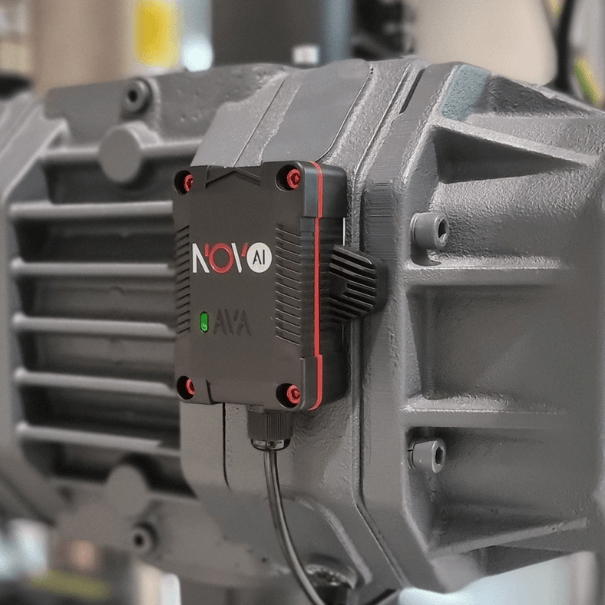
15 Minutes. No IT Project.
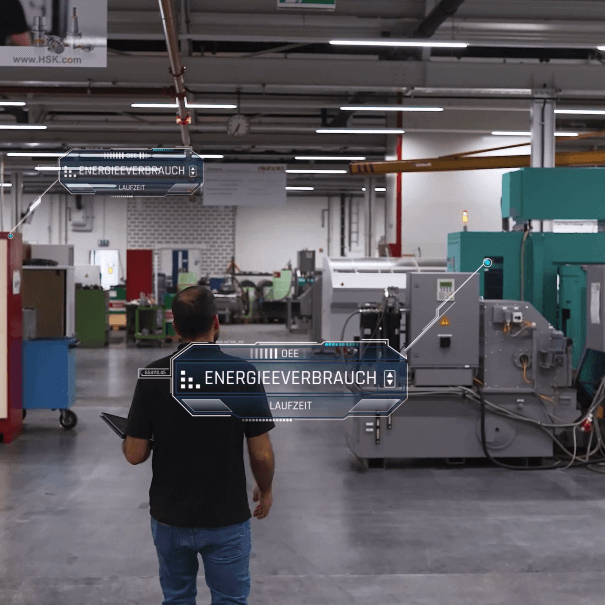
Understanding Makes the Difference.
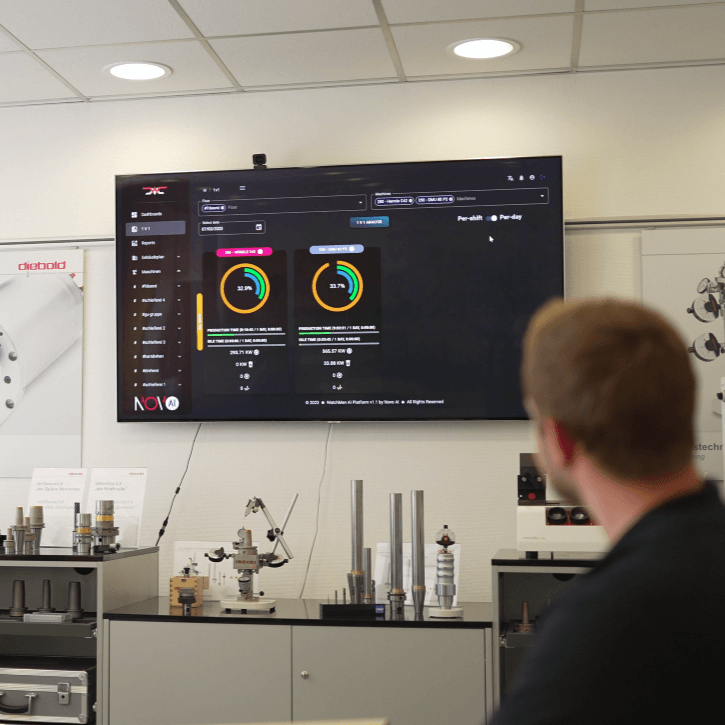
Machine data you can act on.
Companies that trust Novo AI















Machine Data Acquisition in Manufacturing: Fundamentals, Systems, Costs and Implementation
Maschinendatenerfassung ist für moderne Fertigungsunternehmen kein reines Digitalisierungsprojekt mehr. Sie ist die Grundlage dafür, Produktionsprozesse realistisch zu bewerten, Stillstände sichtbar zu machen, Maschinen besser auszulasta
Machine data acquisition is no longer simply a digitalization project for modern manufacturing companies. It provides the foundation for evaluating production processes realistically, identifying downtime, improving machine utilization, and making decisions based on reliable production data rather than gut feeling, shift reports, spreadsheets, or delayed feedback.
However, machine data acquisition is often more difficult in established machine parks than it initially appears. Many manufacturers operate a combination of modern machines, older equipment, different machine brands, different control systems, and machines without accessible digital interfaces.
For this reason, successful machine data acquisition requires more than a technical connection to a machine. It requires a system that transforms machine signals into understandable and actionable production information.
At Novo AI, machine data acquisition means more than collecting signals. It means making machine conditions, idle time, downtime, micro-stops, and process deviations visible so that production managers, shift supervisors, and company management can immediately identify where time, energy, and performance are being lost.
en und Entscheidungen nicht länger auf Bauchgefühl, Schichtzetteln oder verspäteten Rückmeldungen aufzubauen.
Gerade in gewachsenen Maschinenparks ist das Thema jedoch oft schwieriger als es auf den ersten Blick wirkt. Viele Unternehmen haben moderne Maschinen, ältere Anlagen, verschiedene Hersteller, unterschiedliche Steuerungen und nicht überall eine saubere Schnittstelle. Genau deshalb braucht Maschinendatenerfassung nicht nur eine technische Verbindung zur Maschine, sondern ein System, das aus Maschinensignalen verständliche Produktionsinformationen macht.
Bei Novo AI bedeutet Maschinendatenerfassung deshalb: nicht nur Signale sammeln, sondern Maschinenzustände, Leerlauf, Stillstände, Mikrostopps und Abweichungen so sichtbar machen, dass Produktionsleiter, Schichtleiter und Geschäftsführung sofort erkennen, wo Zeit, Energie und Leistung verloren gehen.
What Is Machine Data Acquisition?
Machine data acquisition refers to the automated collection of data from production machines. This can include machine conditions, operating time, downtime, idle time, cycle times, quantities, energy consumption, production-order information, and process signals.
The objective is not to collect as much data as possible. The objective is to establish a reliable view of what is actually happening on the shop floor.
According to the production plan, a machine may be scheduled to operate productively for eight hours. In reality, setup time, micro-stops, material shortages, operator interventions, idle periods, and unplanned downtime may consume a significant portion of that time.
Without machine data acquisition, these losses often remain invisible or are only discovered much later.
A good machine data acquisition system therefore does not only answer the question:
- “Is the machine connected?”
It should answer the questions that are relevant to daily production:
- “Is the machine actually producing?”
- “Where is downtime occurring?”
- “Which machine is repeatedly losing production time?”
- “Which shift is operating more consistently?”
- “Which production orders are performing differently from the plan?”
- “Where is energy being wasted during idle periods?”
- “Which data can help us make better decisions?”
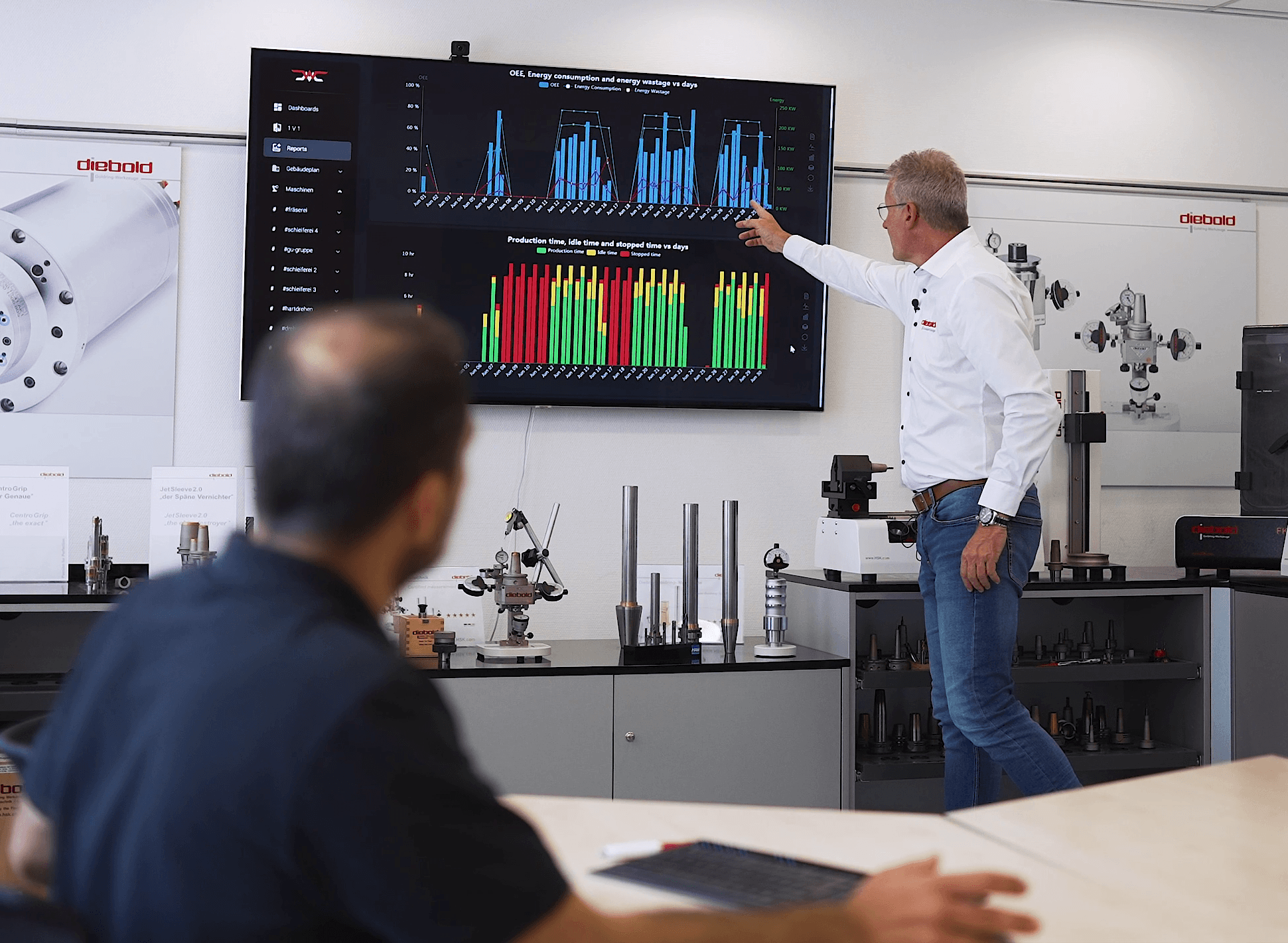
Machine data acquisition therefore provides the data foundation for OEE, production monitoring, downtime analysis, energy optimization, production-order controlling, and continuous improvement.
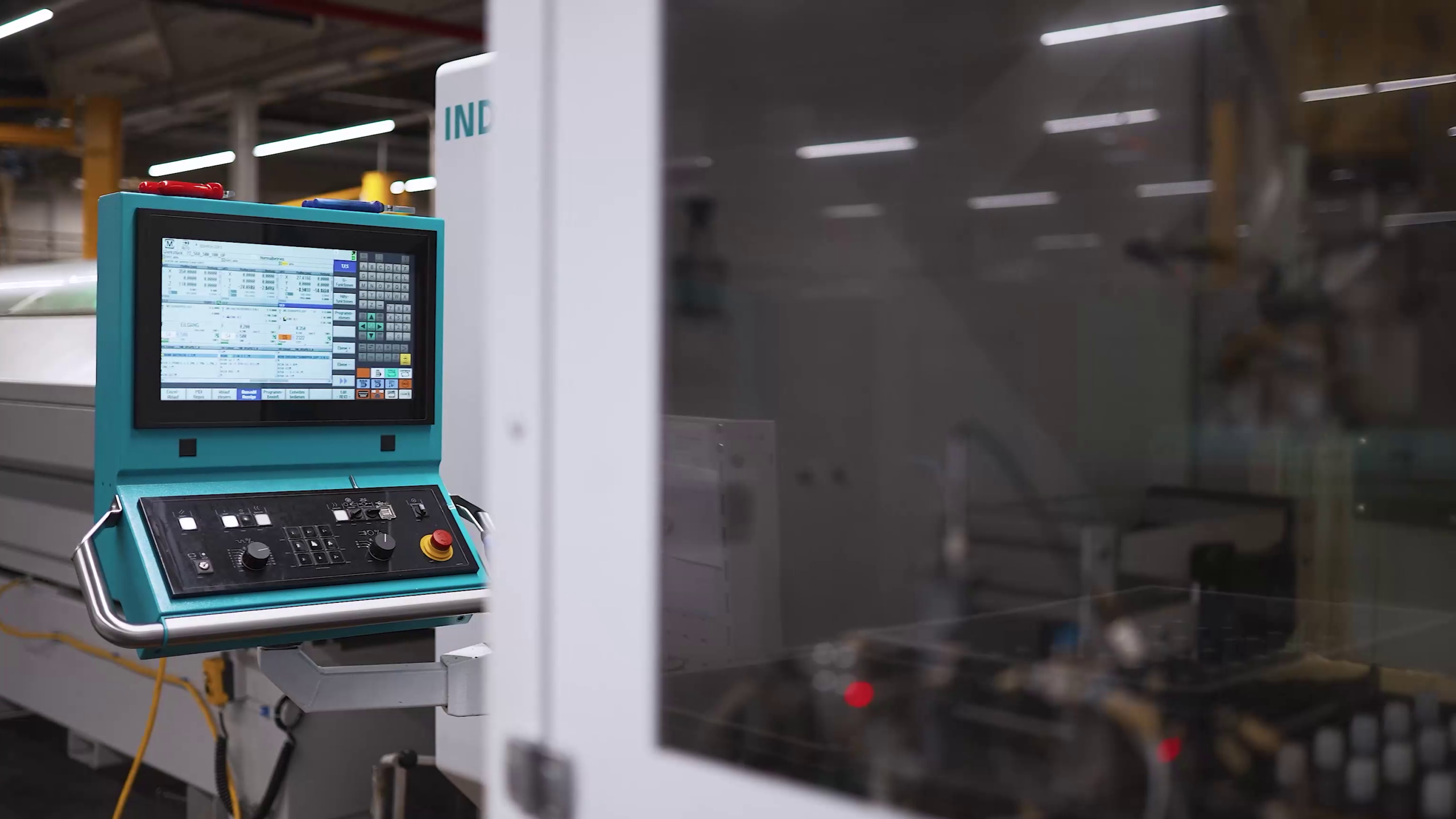
Which Machine Data Is Really Important?
Not every available machine variable is automatically valuable. In practice, the most important data is the data that production teams can use to identify problems and initiate meaningful corrective actions.
Machine Status: Production, Idle Time and Downtime
The most important starting point is the current machine status.
Is the machine producing? Is it running without creating output? Is it switched off? Is it being prepared, set up, or experiencing a fault?
This basic distinction is essential because many production losses do not appear in the official production plan.
A machine can be switched on, generate noise, move, and consume energy without producing anything of value. The distinction between a machine that is merely running and a machine that is actually producing is therefore particularly important for manufacturing companies.
Operating Time and Downtime
Operating time shows how long a machine was active. Downtime shows how long it was unavailable or unable to produce.
Both values are necessary for evaluating machine availability realistically.
Without automated data acquisition, downtime is often estimated, documented too late, or not recorded at all. Production managers may recognize that performance is missing but remain unable to identify exactly where the production time was lost.
Micro-Stops
Micro-stops are brief interruptions that may appear insignificant individually but can accumulate into substantial losses over days and weeks.
They may be caused by minor faults, short operator interventions, material replenishment, brief waiting periods, or unstable processes.
The problem is that micro-stops are almost never documented reliably by hand. Nobody records every five-second, ten-second, or thirty-second interruption.
A good machine data acquisition system identifies these small losses automatically and shows whether they occur randomly or follow a recurring pattern.
Cycle Times
Cycle times show how long a production cycle, stroke, cut, bending operation, milling operation, or other processing step actually takes.
This makes it possible to compare planned and actual performance.
Increasing cycle times may indicate tool wear, process problems, differences in machine operation, material issues, unstable production conditions, or unrealistic planning data.
Production Quantities
Production quantities show how much output was actually produced.
When quantities are connected with machine conditions, cycle times, and production-order data, manufacturers can distinguish between a machine that is simply operating and a machine that is producing according to plan.
Depending on the machine and process, quantities can be detected automatically or combined with production-order and production-data-acquisition information.
Production-Order Context
Machine data becomes significantly more valuable when it can be assigned to a production order.
Production teams can then see not only that a machine stopped, but also which production order was affected.
This is important for actual cost analysis, delivery reliability, production planning, and process improvement.
Without production-order context, machine data acquisition often remains a purely technical view. With production-order context, it becomes a practical tool for production control and operational controlling.
Energy Consumption
Energy consumption is not only a sustainability topic. It can also reveal wasted machine time.
When a machine consumes energy while idling without producing output, unnecessary costs are created.
This effect can become particularly significant for energy-intensive machines, long idle periods, extended waiting times, and processes with a high proportion of non-productive time.
OEE
OEE stands for Overall Equipment Effectiveness and combines availability, performance, and quality.
The metric helps manufacturers evaluate the effectiveness of machines and production systems more objectively.
Machine data acquisition provides the underlying data required for reliable OEE calculation. Without accurate operating times, downtime, cycle times, and production quantities, OEE often remains an estimate.
With automated machine data acquisition, OEE becomes more reliable and can be used as a foundation for targeted improvement measures.
Downtime Reasons
Knowing that a machine has stopped is the first step. Knowing why it stopped is the second.
Downtime reasons can be detected automatically, added by machine operators, or combined with production-order and process data.
The underlying logic must remain clear. Too many downtime categories make reporting confusing. Too few categories provide insufficient information for root-cause analysis.
The best results are achieved by combining automated detection with simple and clearly structured operator input.
Shift Comparison
Many production problems only become visible through comparison.
The same machine and the same product may produce very different results depending on the shift. Differences may appear in output, downtime, cycle times, idle time, or process stability.
A structured shift comparison helps manufacturers identify patterns, recognize best practices, and provide targeted support where processes are not operating consistently.
Machine Data Acquisition vs. Production Data Acquisition vs. ERP
Machine data acquisition, production data acquisition, ERP, and MES are frequently treated as if they perform the same function.
For an effective digitalization strategy, it is important to separate their roles clearly.
System
What It Shows
Typical Limitation
Machine data acquisition primarily answers:
“What is happening at the machine?”
Production data acquisition additionally answers:
“What was reported by the operator, production order or shift?”
The ERP system answers:
“What was planned, calculated, purchased, produced or sold?”
The greatest value is created when these different information layers are connected.
Production teams can then see not only that a machine has stopped, but also which production order is affected, which planned time was stored in the ERP system, whether feedback is missing, and how significantly actual production differs from the plan.
This is where basic data collection becomes genuine production intelligence.
Why Traditional Machine Data Acquisition Projects Often Fail
Many machine data acquisition projects do not fail because data is unavailable. They fail because the collected data never becomes usable.
A common mistake is assuming that machine data acquisition is complete as soon as a machine has been technically connected.
In practice, connecting the machine is only the beginning.
For machine data acquisition to create value, several steps must work together:
- The machine must be accessible.
- Its signals must be interpreted correctly.
- The data must be structured meaningfully.
- The information must be visualized clearly.
- The data must be connected with the relevant production order, shift, or process.
- The resulting insights must lead to concrete action.
When only the first step is completed, the result is often a technical data graveyard.
The machine sends values, but nobody knows which values are relevant, what they mean, or which production decision should follow.
Existing and legacy machines create additional challenges.
Not every machine supports OPC UA. Not every machine control is open or accessible. Not every manufacturer provides access to its interfaces. Many older machines do not generate clean digital production data.
Even when an interface is available, integration can require extensive coordination, implementation time, and internal IT resources.
Novo AI reduces this initial barrier because the first step does not have to become a large PLC, OPC UA, or MES project.
Manufacturers can begin with the AI sensor and WatchMen, make real machine conditions visible, and then add ERP, production data acquisition, or MES integrations where they create measurable value.
Machine data acquisition therefore becomes a practical entry point into transparent manufacturing rather than a lengthy IT project.
Machine Data Acquisition Software: Which Functions Should It Provide?
Good machine data acquisition software must do more than display data.
It should help production teams identify deviations, narrow down possible causes, and initiate corrective action more quickly.
Important functions include the following.
Automated Machine-State Detection
The system should recognize whether a machine is producing, idling, stopped, switched off, or operating in an unclear condition.
This detection should be as automated as possible so that production transparency does not depend entirely on manual operator input.
Downtime and Micro-Stop Detection
Downtime must not only be visible. It should also be analyzable by duration, frequency, machine, shift, and production order.
Micro-stop detection is particularly important because these short interruptions are almost impossible to capture reliably through manual documentation.
Cycle-Time and Performance Monitoring
The software should show whether a machine is operating faster, slower, or less consistently than expected.
This makes planned-versus-actual deviations visible before they appear in a monthly production report.
OEE Calculation
OEE should not have to be calculated manually using spreadsheets.
Machine data acquisition software should automatically combine availability, performance, and the relevant production data so that OEE becomes a usable operational metric.
Energy and Idle-Time Analysis
Energy data becomes particularly valuable when it is connected with machine conditions.
Manufacturers can then see not only how much energy was consumed, but also whether that energy contributed to productive output.
Production-Order and Shift Context
Machine data without context has limited value.
By connecting machine data with production orders and shifts, manufacturers can identify which orders run consistently, which machines repeatedly deviate from the plan, and whether specific shifts or periods show unusual patterns.
Shop-Floor Dashboard
A good dashboard must be understandable in daily production.
It should work not only for analysts, but also for production managers, shift supervisors, and employees on the shop floor.
Important elements include clearly defined machine conditions, simple visual indicators, understandable timelines, and direct answers to the question:
“Where do we need to take action today?”
Alerts and Escalation
Machine data acquisition becomes especially valuable when responsible employees do not have to monitor dashboards continuously.
Relevant alerts can inform the appropriate people when critical deviations occur. Examples include:
- a machine is running but no production order is active
- downtime exceeds a defined duration
- production progress falls significantly behind plan
- idle time becomes unusually long
- performance or cycle times deviate strongly from the target
Effective alerting also requires protection against notification overload.
Not every small deviation requires a message. Good alerting means sending a small number of relevant notifications that lead to action.
Historical Analysis
In addition to live production monitoring, manufacturers need historical analysis and pattern recognition.
Which machine has accumulated the most downtime over several weeks? Which downtime reasons occur repeatedly? Which shift has the most stable cycle times? Where has OEE actually improved?
Historical analysis turns daily observations into long-term production improvement.
Export, API and ERP Integration
Machine data acquisition software should not operate as an isolated system.
Depending on the objective, information may need to be exported or connected with ERP, PDA/BDE, MES, or other business systems.
However, integrations should be introduced where they create operational value—not as a technical objective in themselves.
The difference with Novo AI is that WatchMen is not only a dashboard. It acts as a production assistant.
The platform detects machine conditions, highlights deviations, makes downtime understandable, and informs responsible employees at the right time so that machine data leads to concrete action.
Acquiring Machine Data Without PLC Intervention
Many traditional machine data acquisition projects depend heavily on PLC access, OPC UA, industrial gateways, or machine-specific interfaces.
This may work well for modern machines. In a mixed machine park, however, the process can quickly become complicated.
Typical challenges include:
- older machines without modern interfaces
- different machine manufacturers and control systems
- closed or difficult-to-access PLC systems
- extensive coordination with machine manufacturers
- risks associated with changing existing machine controls
- lengthy IT and integration projects
- machines for which a traditional interface connection is not economically viable
This is precisely why Novo AI’s approach is particularly relevant for existing and legacy machines.
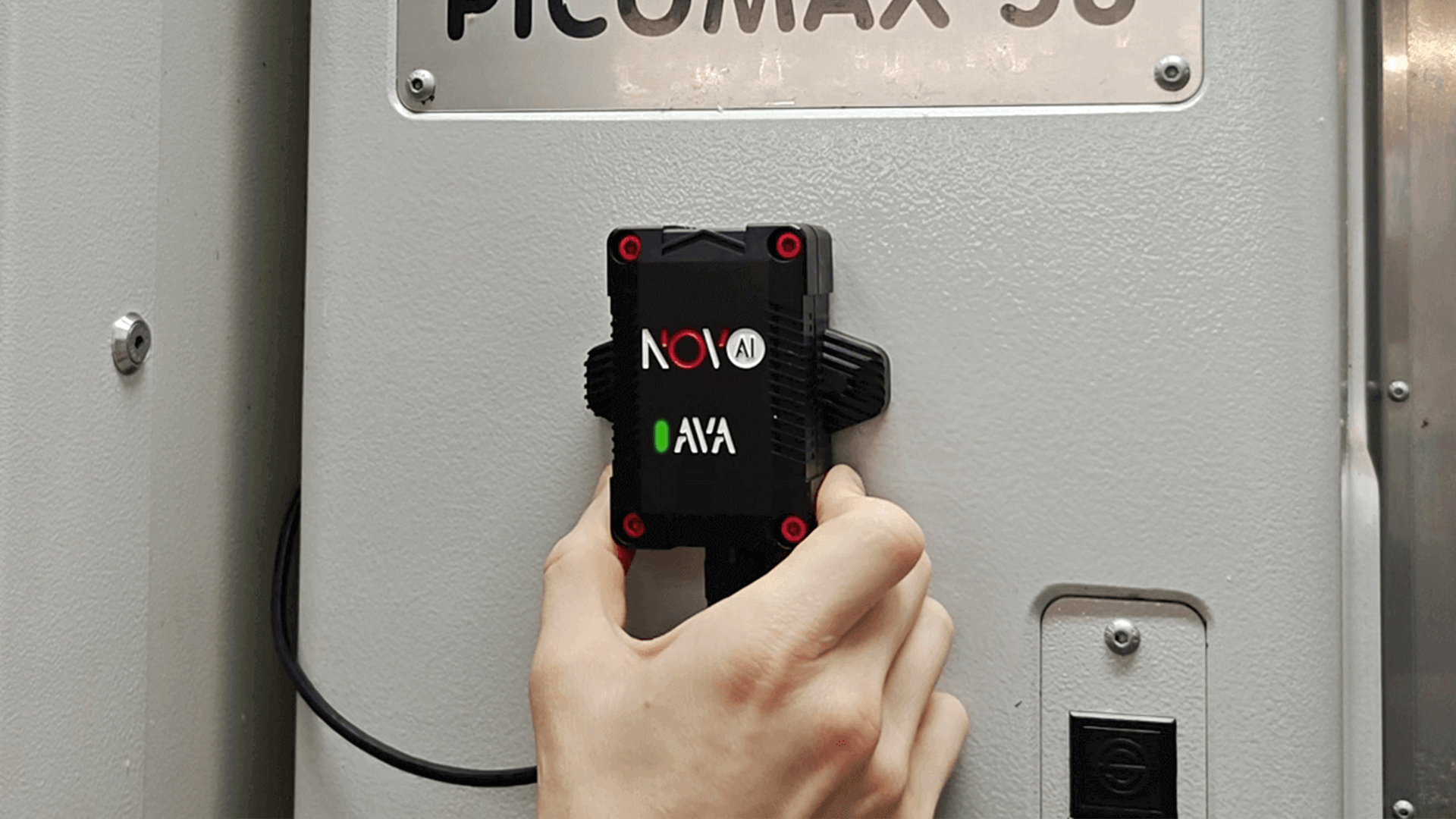
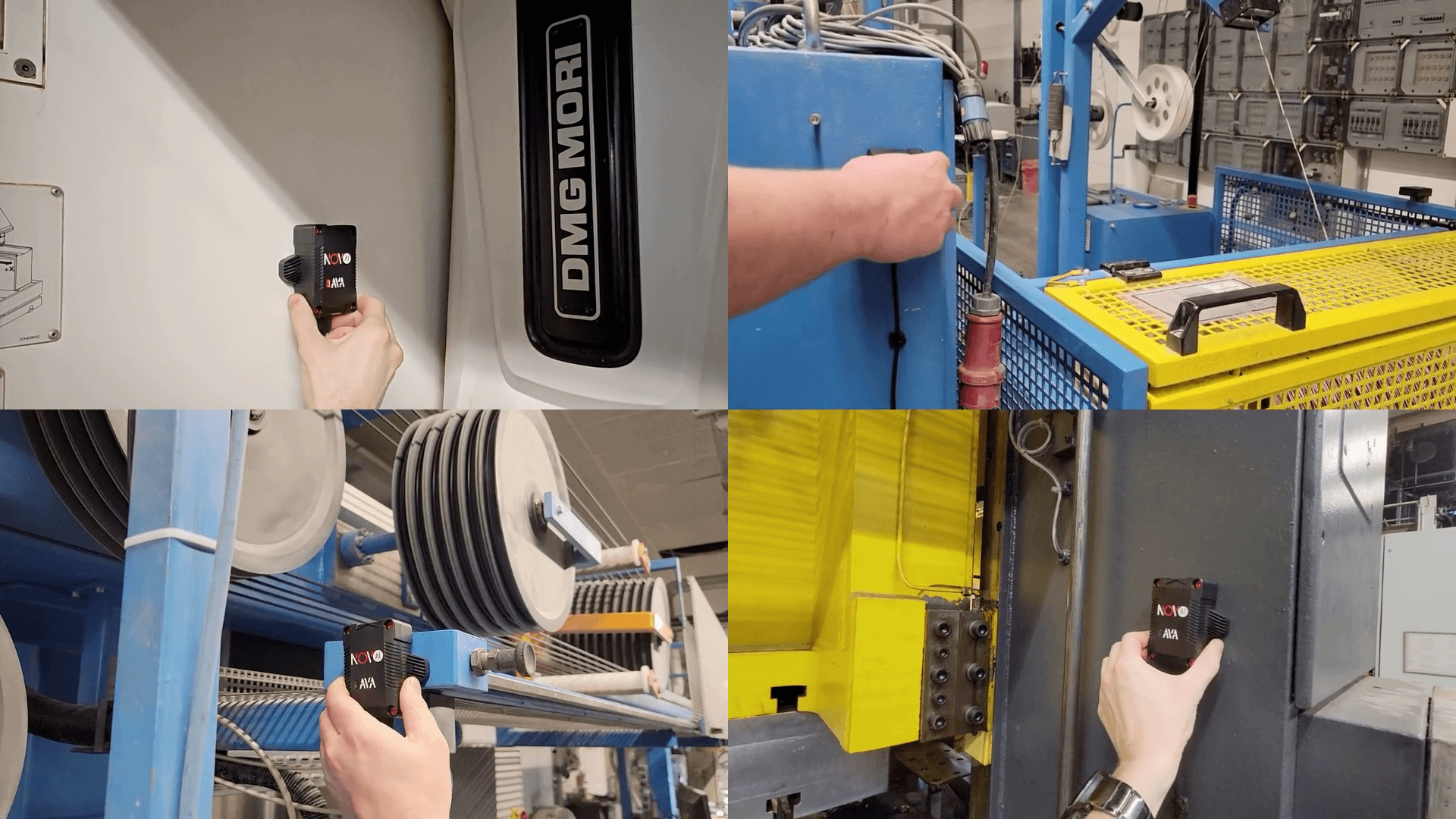
The AI sensor is mounted externally on the machine. The machine does not need to be replaced, and the control system does not need to be reprogrammed.
Instead of intervening deeply in the PLC, the sensor captures physical signals such as vibration and acoustic patterns and evaluates them using edge processing.
This produces actionable information about machine conditions, idle time, downtime, production phases, and process deviations.
WatchMen displays the information in an understandable interface and transforms the detected conditions into production-relevant KPIs.
The advantages for manufacturing companies include:
- external sensor installation
- no intervention in the machine control system
- reduced risk associated with PLC programming
- suitable for older machines
- suitable for mixed machine parks
- edge processing directly on the device
- actionable machine conditions instead of unstructured raw data
Learn more: Machine Retrofit
Practical Machine Data Acquisition Use Cases
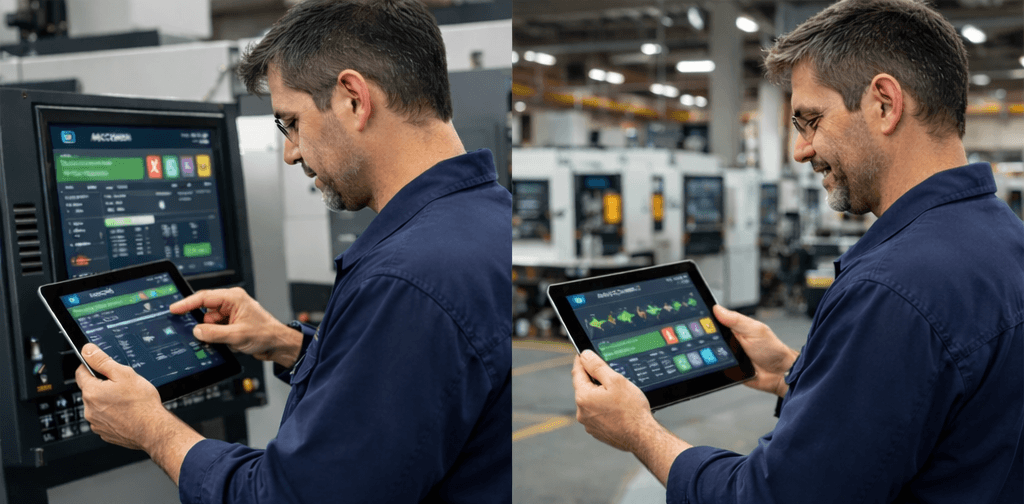
Machine data acquisition becomes valuable when it reveals concrete problems from daily production.
The following examples represent situations that occur in many manufacturing companies.
Example 1: The Machine Is Running, but the Production Order Has Not Been Started
The machine is active on the shop floor, and the production plan appears normal.
However, the production order has not been correctly started or reported in the ERP or production data acquisition system.
Without a connection between the machine’s actual activity and production-order information, this gap can remain undetected for a long time.
Later, reliable data may be missing for actual cost analysis, production-progress evaluation, or future planning.
WatchMen can identify when a machine is running without an assigned active production order.
The shift supervisor can therefore respond early instead of correcting incomplete or inaccurate production feedback later.
Example 2: Micro-Stops Consume Production Time Every Day
A machine does not stop long enough for the interruption to be recognized as major downtime.
Nevertheless, small interruptions occur repeatedly: a few seconds, half a minute, or two minutes at a time.
Individually, these stops appear harmless. Across one shift, one week, or one month, however, they can consume a substantial amount of production time.
Automated machine data acquisition makes these micro-stops visible.
Production managers can determine whether they occur randomly or whether a recurring operational pattern is responsible.
Example 3: Idle Time Is Mistaken for Productive Time
Many machines consume energy and generate signals even when they are not creating productive output.
From the perspective of the control system or a brief manual observation, the machine may appear to be running.
In reality, it is idling.
This is where the distinction between machine activity and productive value creation becomes essential.
Novo AI helps manufacturers separate these conditions so that they can see not only whether a machine is switched on, but whether it is actually producing.
Example 4: OEE Is Lower Than Expected
Many manufacturing companies have an impression of which machines are performing well and which machines are underperforming.
Reliable data is required to determine whether this impression is accurate.
The machine with the longest individual downtime event may not be the primary problem. Another machine may lose more time through hundreds of micro-stops.
Availability may appear acceptable while actual performance remains permanently below the target.
Losses may also be concentrated in specific shifts, production orders, or products.
Machine data acquisition reveals these differences and provides the foundation for targeted production improvements.
Example 5: Energy Is Wasted During Idle Time
Energy consumption is particularly expensive when it does not create output.
Many machines continue consuming electricity during waiting periods, secondary activities, or unclear production interruptions.
When energy consumption is connected with machine conditions, manufacturers can identify not only how much energy was consumed but also why it was consumed.
This makes it possible to identify machines with particularly high idle-time energy consumption and locate opportunities for rapid savings.
Costs and ROI of Machine Data Acquisition
The cost of machine data acquisition depends heavily on the machine park, the required functions, and the desired integration model.
Manufacturers should therefore evaluate not only the price per machine but also the expected operational value.
Important cost drivers include:
- number of machines
- sensors and hardware
- WatchMen SaaS usage
- ERP, PDA/BDE, or MES integration
- tablets or shop-floor terminals
- additional energy measurement where required
- pilot size compared with a complete rollout
- required alerting and escalation logic
- data model and master-data quality
- production-order integration
The ROI is generally not created by collecting data itself.
It is created by identifying and reducing losses that were previously invisible.
These losses can include unplanned downtime, idle time, micro-stops, inaccurate planning data, wasted energy, missing production feedback, and unclear order progress.
A pilot involving a small number of machines is therefore often the most practical starting point.
It quickly shows which losses are actually occurring and whether a rollout to additional machines is economically worthwhile.
Calculate when machine data acquisition will pay for itself in your machine park.
Learn more:
Price Calculator
ROI Calculator
How Manufacturing Companies Can Start with Machine Data Acquisition
A machine data acquisition project does not have to begin as a large IT project.
For many small and medium-sized manufacturers, a pragmatic step-by-step approach is more effective.
1. Select Three Pilot Machines
Start with machines where production losses are suspected or where performance is particularly important.
Suitable pilot machines may include:
- bottleneck machines
- machines with frequent downtime
- older existing machines
- machines with unclear utilization
- machines with unstable cycle times
- energy-intensive machines with suspected idle-time losses
2. Define the Objectives
Define what the pilot should make visible.
Typical objectives include:
- OEE
- downtime
- idle time
- micro-stops
- energy consumption
- production-order progress
- cycle-time deviations
- shift comparison
Without clearly defined objectives, the project can quickly become a general data-collection exercise.
With clearly defined objectives, it becomes a production-improvement project.
3. Install the Sensor
The AI sensor is mounted externally on the machine and connected to power and the network.
The acquisition of relevant machine signals can then begin without reprogramming the machine control.
4. Review the First Machine Conditions in WatchMen
WatchMen displays machine conditions, timelines, and initial KPIs.
At this stage, manufacturers often discover whether their previous assumptions about operating time, idle time, and downtime match the actual production data.
5. Analyze Downtime and Micro-Stops
After the initial data-acquisition period, the production team should review which losses occur repeatedly.
The focus should not only be on the largest individual fault.
The total impact of many small production interruptions can be equally or even more important.
6. Define Alert Rules
Once the most important patterns are understood, meaningful alerts can be configured.
Examples include:
- machine running without an active production order
- downtime exceeding a defined duration
- production-order progress falling behind plan
- unusually long idle period
- performance or cycle time deviating significantly from the target
A small number of well-designed alerts is more effective than a large number of irrelevant notifications.
7. Add ERP or Production Data Integration
ERP, PDA/BDE, or MES information should be connected where it creates the most value.
The connection between the machine, production order, shift, and production feedback is particularly valuable.
This transforms technical machine data acquisition into a tool for production control, actual cost analysis, and planning.
8. Plan the Rollout to Additional Machines
After the pilot, the company can decide which machines should be connected next.
Prioritization should not be based on gut feeling. It should be based on potential:
- Where are the largest production losses occurring?
- Where is transparency currently lowest?
- Which machines influence overall throughput?
- Where can measurable benefits be achieved quickly?
- Which machines consume the most energy while idling?
FAQ: Machine Data Acquisition
Machine data acquisition is the automated collection of data from production machines.
This can include machine conditions, operating times, downtime, idle time, micro-stops, cycle times, quantities, energy consumption, and process signals.
The objective is to make actual machine performance visible and analyzable.
Machine data acquisition software is a system that collects, structures, visualizes, and analyzes machine data.
Good machine data acquisition software does not only display values. It helps manufacturers identify downtime, performance losses, deviations, and improvement opportunities.
Machine data acquisition collects information directly from or at the machine.
This can include conditions, cycles, quantities, downtime, and physical signals.
Production data acquisition records operational information such as production-order times, quantities, operator feedback, shift information, and downtime reasons.
In practice, the greatest value is created when machine data acquisition and production data acquisition are combined.
Yes. Machine data can be acquired without directly accessing or changing the PLC.
Novo AI uses an AI sensor that is mounted externally on the machine and analyzes physical signals such as vibration and acoustic patterns.
This makes machine conditions and process deviations visible without reprogramming the control system.
Yes. Retrofit-capable machine data acquisition is particularly valuable for older machines.
Many legacy machines do not have modern digital interfaces or are difficult to include in traditional IT integration projects.
External sensor technology makes it possible to include these existing machines in production monitoring.
Novo AI is suitable for many machine types within mixed machine parks, including:
CNC machines, milling machines, lathes and turning machines, bending machines, press brakes, saws, laser-cutting machines, injection-moulding machines, presses, packaging machines, extrusion machines and additional industrial production machines
The key requirement is that the machine generates physical signals that can be analyzed.
Depending on the machine and setup, it is possible to visualize machine status, runtime, downtime, idling, micro-stops, cycle times, production quantities, energy consumption, job-related data, shift comparisons, and OEE-relevant data.
The exact timeframe depends on the machine park and setup.
The advantage of a sensor-based approach is that manufacturers can make the first machines visible quickly without immediately beginning a major PLC or MES project.
A pilot involving a small number of machines is particularly useful for obtaining reliable initial insights quickly.
ERP integration is not essential for getting started.
Many manufacturers begin by monitoring machine conditions, downtime, idle time, micro-stops, and OEE-related data.
ERP or production data integration becomes particularly valuable when machine information needs to be connected with production orders, planned times, quantities, delivery dates, or actual cost analysis.
OEE combines availability, performance, and quality.
Machine data acquisition helps manufacturers calculate availability and performance more realistically because operating time, downtime, micro-stops, and cycle times are captured automatically.
Quality data can then be added depending on the available production-data structure.
The cost depends on the number of machines, sensor requirements, software functions, integrations, energy measurement, tablets, and rollout size. A pilot is therefore often the best starting point.
It allows the company to determine which production losses become visible and estimate the economic potential across the machine park.
A successful MDE pilot begins with a few selected machines, clear objectives, and a brief evaluation phase. Typical steps include: selecting pilot machines, installing sensors, checking initial status data in WatchMen, analyzing downtimes and micro-stops, defining alarm rules, and subsequently deciding on the rollout.
From Machine Data to Better Decisions
Machine data acquisition creates value only when the data leads to better decisions.
Manufacturing companies do not need more complicated charts. They need clarity about where performance is being lost, which machines are deviating from the plan, and which improvement measures should be prioritized.
Novo AI makes this transparency accessible for existing machine parks through the AI sensor, edge processing, and the WatchMen platform.
Without replacing machines.
Without deep intervention in the machine control system.
Without a months-long IT project.
Start with a small number of machines, identify real production losses, and then use reliable data to decide where a broader rollout will create the greatest value.
Which Machines Does Novo AI Support?
DMG MORI, Mazak, Okuma, Haas Automation, Makino, JTEKT, GF Machining Solutions, Trumpf, Hurco, EMAG, CHIRON, MAG / MAG IAS, Hardinge, Amada, TSINFA, Sodick, Methods Machine Tools, Jyoti CNC Automation, Fanuc, Siemens, TRUMPF
Learn more: Capture Data from CNC Machines
TRUMPF, AMADA, Bystronic, Durma, Baykal, SafanDarley, Gasparini, Jorns, Hämmerle, EHT, LVD, Danobat, BLM Group, FACCIN, DAVI, WAFIOS, NUMALLIANCE, Herber, YLM, CML, REMS, Bernardo, KNUTH, HEZINGER, Stierli-Bieger, Altendorf, RAS, Pedax, AMB PICOT, Holzmann, Epple, LECHNER, HSM, TRACTO-TECHNIK, KRENN, BJZ, RASI, Vingriai, Reinhard Klein
Learn more: Capture Data from Bending Machines
TRUMPF, AMADA, Bystronic, Durma, SafanDarley, LVD, Baykal, Gasparini, Hämmerle, EHT, Jorns, CoastOne, Prima Power, Yawei, Ermaksan, Cincinnati, HACO, Deratech, Schröder, Ermaksan, JFY, Yangli, VLB Group, Dener, Vimercati, Dimeco, IMAC, G.A.D.E., Bernardo, KNUTH, Stierli-Bieger, HEZINGER, BLEMA, Epple, Holzmann, BPR, STR, Danobat, Eisele, Colly, Schechtl, HACO-Kingsland, RICO, Beyeler (heute Bystronic), Pullmax, Pivatic, Darley, UZMA, RASI, Reinhard Klein, Vingriai, LVD-EHT, Hämmerle, Metallkraft, Biegetechnik Müller, MUBEA
Learn more: Capture Data from Press Brakes
Union, TOS Varnsdorf, Scharmann, Dörries Scharmann, Wotan, Pama, JUARISTI, SORALUCE, FPT, Lazzati, Skoda, Ingersoll, Giddings & Lewis, Lucas, HBM Machines, Toshiba, Asquith, Berthiez, Lymco, You Ji, Kira, Nomura, Dainichi, Alesa Monti, Sacem, Sacem-Greda, FERMAT, Kuraki, Zayer, Huller Hille, SIP, Stanko, Binns & Berry, Devlieg, Kearns-Richards, Henri Line, Niles-Simmons, Colgar, Comev, Giana, Jobs, San Rocco, Heckert, Cincinnati Gilbert, Rambaudi, Csepel, Tos Hostivar, Mecof, Sachman, Hüller Hille, Mandelli, MTE, Boehringer, Rambaudi, Froriep, Naxos Union
Learn more: Capture Data from Drilling Machines
DMG MORI, Gildemeister, Mazak, EMAG, Okuma, Haas, Weiler, INDEX, Doosan, Spinner, Hyundai WIA, Takisawa, Colchester, Tornos, Hwacheon, Hardinge, Biglia, Monforts, Schaublin, Mischungen aus modernen CNC-Zentren und älteren manuellen Maschinen
Learn more: Capture Data from Turning Machines (Lathes)
Fräsmaschinen von DMG MORI, Mazak, Hermle, HAAS, Okuma, Chiron, Makino, Hurco, Deckel Maho, Heller, Bridgeport, Kearney & Trecker, Schaublin, Gildemeister, Matsuura, Doosan, Cincinnati, Aciera, Emco, Hwacheon, Spinner, Colchester, Mikron, Fehlmann, Lagun, Hartford, Fexac, Weiler, Maho, Kondia, Sigma, Kitamura, Leadwell, ZPS, Toshiba, TOS, MTE, Deckel, Rambaudi, Giddings & Lewis
Learn more: Capture Data from Milling Machines
TRUMPF, Bystronic, AMADA, Mazak, LVD, Prima Power, Mitsubishi Electric, Eagle, HSG Laser, Bodor, Han’s Laser, Trotec, Coherent (Rofin), IPG Photonics, Raycus, Ermaksan, Cincinnati, MicroStep, HGTech, Golden Laser, Salvagnini, Dener, Yawei, Durma, Baykal, Dreis & Krump, Tanaka, Farley Laserlab, ACL, Koike, Penta Laser, Senfeng, Bylaser, ESAB Lasertec, Laserlab, Haco-Laser, HF Laser, Optonics, Mischung aus CO₂-Anlagen, modernen Faserlasern, fliegender Optik, Portalmaschine, Kombianlagen mit automatischer Be- und Entladung
Learn more: Capture Data from Laser Cutting Machines
Ekato, Netzsch, Ystral, Lödige, Drais, IKA, Hosokawa Micron, BHS-Sonthofen, Zeppelin Systems, Mixaco, VMI, Lindor, Winkworth, Silverson, Hockmeyer, Gericke, B&P Littleford, Amixon, Charles Ross & Son, Morton, PerMix, Henschel, Bühler, Lodige Process Technology, Hüttlin, Volkmann, Maschinenfabrik Gustav Eirich, Fielder, Diosna, Vortex, Lodige, Hüttlin, Hecht, Bepex, Matcon, Forberg, Romaco, Bohle, Teagle, Kemutec, Processall, Omga-Mix, Scott Turbon, Jaygo, Nauta, Lodige Werke, Eppensteiner, Mischtechnik Schwab, Allgaier, Alpine, MÜLLER Mischtechnik, Schugi, Littleford Day, Collette, Kestner, WAB Willy A. Bachofen
Learn more: Capture Data from Mixing and Stirring Machines
Behringer, KASTO, MEBA, Amada, Kaltenbach, Bomar, Beka-Mak, Ficep, Everising, Trennjaeger, Danobat, Pedrazzoli, Eisele, Hyd-Mech, Imet, Soitaab, Berg & Schmid, Pressta-Eisele, Rusch, Julia, Emmegi, Cosen, ExactCut, MACC, Tecnomac, Nishijimax, HUVEMA, Rusch, MEP, BSM, BTM, KMT, Voortman, Bianco, DoAll, Friggi, Thomas, SABI, Karmetal, Peddinghaus, Forte, Pegic, Kaltmeier, Säge-Union, Schanbacher, RASOMA, PNK-Maschinenbau
Learn more: Capture Data from Sawing Machines (Saws)
Schuler, Aida, Andritz Kaiser, Bruderer, Erfurt, SEYI, Komatsu, Mecfond, Chin Fong, AP&T, Beutler Nova, Fagor Arrasate, Bliss, Minster, Sangiacomo, SIMPAC, Sutherland, Manzoni, Stamtec, Heilbronn, Erichsen, Ebu, Smeral, Lasco, LVD, Wemhöner, Kraus, Fischer, Dreis & Krump, Balconi, Schmedt, Rossmann, Yadon, IMS, Weingarten, Voest-Alpine, Kaiser Pressen, Dunker, Peddinghaus, Sachs, Rossi, Neff, Kieserling
Learn more: Capture Data from Punch Presses
ELB, Blohm, Jung, Okamoto, Studer, Kellenberger, Reform, KEHREN, ABA, Geibel & Hotz, Tschudin, LIZZINI, Campbell Grinder, Lodi, WEMA, Voumard, Mägerle, Lodi Grinding, TOS Hostivař, Micron, Danobat, Palmary, Supertec, KUGEL, Tschudin, Koyo, Cylindrix, Tacchella, DELTA, Cincinnati Milacron, Jones & Shipman, KMT, Erwin Junker, Lodi, Fortschritt, REKORD, Stankoimport, Praga, Karstens, Reinhard Klein
Learn more: Capture Data from Grinding Machines
Arburg, Engel, KraussMaffei, Sumitomo (SHI) Demag, Wittmann Battenfeld, BOY, Haitian, Negri Bossi, Ferromatik Milacron, Fanuc, Toshiba, JSW, Dr. Boy, Italpresse, MAPLAN, Sandretto, Stork, Chen Hsong, LK Machinery, Tederic, Windsor, Hemscheidt, Battenfeld, Netstal, Hüller Hille, Welltec, Niigata, Toyo, Demag Ergotech, Ankerwerk, SIG Maschinenbau, Mir, Klockner Ferromatic, Satra, Battenfeld Austria, Anker, Hemscheidt Maschinenbau, Heinz Weiler
Learn more: Capture Data from Injection Molding Machines
Fronius, Lorch, EWM, ESAB, Kemppi, Cloos, Rehm, SKS Welding Systems, KUKA, Panasonic, Miller, Lincoln Electric, Migatronic, OTC Daihen, TELWIN, Dalex, CEA, Technolit, Helvi, Orbitalum, Oerlikon, Heron, TBi, Dinse, Carl Cloos, Saf-Fro, Cebora, Ideal-Werk, Fessmann, Hürner, Weco, Kjellberg, KEMPER, Böhler Welding, Soyer, Merkle, Elektra Beckum, Mennekes, Bavaria Schweißtechnik, Elektrodenwerk Bad Liebenwerda, Stürmer, Weltronic, ESM Schweißtechnik, Thyssen Schweißtechnik
Learn more: Capture Data from Welding Machines
SMS group, Schuler, Lasco, Beche, Müller Weingarten, Weingarten, Danieli, Siempelkamp, Wepuko PAHNKE, Fagor Arrasate, Banning, Hydralic Press Company, Schlebach, Ajax, Raufoss, Hasenclever, Mönninghoff, GFM, Niles-Simmons, Sack & Kiesselbach, Eumuco, Ernst Thielenhaus, Ernst Schubert, Dürr, Loewy, Sundwig, MPM, Maschinenfabrik Erfurt, Mavag, Rautomead, Waldrich Siegen, UnionChemnitz, Fagor Ederlan, SKET, Cincinatti, Farrel, HITACHI Zosen, Kobe Steel, Komatsu, Inoue, Omav, HMP, Eumuco, Makino, UBE Industries, Boehringer, Carl Wezel, Rautenbach, Naxos Union, Mannesmann Demag, Davy McKee, Aichelin
Learn more: Capture Data from Forming Machines
Krones, Bosch Packaging Technology (heute Syntegon), MULTIVAC, IMA, Rovema, Optima, Gerhard Schubert, Theegarten-Pactec, LoeschPack, ULMA, Marchesini, Uhlmann, GEA, Ilapak, Cavanna, Ishida, KHS, SIG, Bradman Lake, Pacmac, Fuji Packaging, Norden, Romaco, Coesia, HASSIA, HMC, Trepko, MGS, Volpak, ACMA, Cama Group, Tisma, OK International, Smipack, Econocorp, Viking Masek, Adco, Sepha, Wrapade, Aesus, Oystar, Waldner Dosomat, Klöckner Medipak, Kalix, Dividella, Oka, Bosch Cartoning, Hayssen, Mateer-Burt, Laudenberg, IWKA, SIG Pack, Mohrbach, BWI Manesty, Manurhin, Kisters, Klockner Bartelt, GRONINGER, Möllers
Learn more: Capture Data from Packaging Machines
Rosendahl Nextrom, Maillefer, Troester, Davis Standard, SAMP, MFL Group, EXTRUDEX, Sikora, Reelex, Queins
Learn more: Capture Data from Extrusion Machines
Niehoff, Maillefer, Rosendahl Nextrom, SAMP, MFL Group, Koch, Mario Frigerio, Henrich, Kieselstein, WAFIOS, Maschinenfabrik Niehoff
Learn more: Capture Data from Wire Drawing Machines
Sikora, Zumbach Electronic, Hipotronics, HighVolt, HFSAB, NDC Technologies, HV Technologies, Megger, BAUR, Phenix Technologies
Learn more: Capture Data from Cable Testing Systems
Schleuniger, Komax, Metzner, Kabatec, Artos, Metzner Maschinenbau, Eraser, Kingsing, Carpenter Manufacturing, Kodera
Learn more: Capture Data from Cable Shielding Machines
Niehoff, Maillefer, Rosendahl Nextrom, Setic, Pourtier, SAMP, Troester, MFL Group, SKET, Caballé, Queins, Watson
Learn more: Capture Data from Stranding Machines
Rosendahl Nextrom, Maillefer, SAMP, Niehoff, Windak, MFL Group, Sikora, Setic, Pourtier, MAG, Bühler, Voith, Aumann, Marsilli, Jota
Learn more: Capture Data from Winding Machines
Sikora, Zumbach Electronic, Rosendahl Nextrom, Maillefer, Beta LaserMike, NDC Technologies, Taihan, HFSAB, Hipotronics
Learn more: Capture Data from Spark Testers
Maillefer, Rosendahl Nextrom, Troester, Davis Standard, SAMP, MFL Group, EXTRUDEX, Queins, Reelex, Windak
Learn more: Capture Data from Jacket Extruders
WiCa, Niehoff, Maillefer, Rosendahl Nextrom, Setic, Pourtier, SAMP, MFL Group, SKET, Caballé, Bartell Machinery, Queins
Learn more: Capture Data from Bow Stranders
Windak, Rosendahl Nextrom, Maillefer, Niehoff, SAMP, MFL Group, Voith, Goebel IMS, Kampf, Atlas Converting, Kampf Schneid- und Wickeltechnik
Learn more: Capture Data from Drum Twisters
Niehoff, Herzog, Wardwell, Spirka Schnellflechter, OMEC, Steeger, Karg, Mayer & Cie, OMAC, KOKUBUN
Learn more: Capture Data from Braiding Machines
Maillefer, Rosendahl Nextrom, SAMP, MFL Group, Niehoff, SKET, Pourtier, Setic, Queins, WiCa
Learn more: Capture Data from Armoring Machines